Brom Bet: The Complete Guide to Sports Betting Success
Updated October 2026
Licensed
Available in US
Fast payouts
18+ Only
Master the art of modern sports betting with comprehensive strategies, platform insights, and expert tips
Brom Bet Guide Why Smart Betting Starts with the Right Platform
Sports betting used to be simple. You'd call your buddy, make a wager on Sunday's game, and that was that. Now?
You're staring at a screen full of numbers, abbreviations, and markets you've never heard of, wondering if you
need a PhD just to place a bet.
Here's the truth: betting platforms like Brom Bet have made wagering more accessible than ever, but they've also
made it more confusing. The learning curve feels steeper than it actually is, and that's by design. The house
always wants you slightly off-balance.
What You'll Learn: This guide cuts through the noise. No corporate speak, no affiliate
pressure, just straight talk about how sports betting actually works on modern platforms. Whether you're
placing your first bet or looking to sharpen your approach, you'll find what you need here.
We're covering everything from reading odds to managing your bankroll like someone who wants to still have money
next month. Let's get into it.
What Is Brom Bet and Why It Matters
Brom Bet represents the current generation of online sportsbooks, platforms that have evolved far beyond their
brick-and-mortar ancestors. While traditional betting required physical presence at specific locations, digital
platforms now put thousands of betting markets in your pocket. This shift has democratized access, but it's also
created new challenges.
The Platform Ecosystem
The platform operates on a straightforward premise: it connects bettors with betting markets across dozens of
sports, from mainstream options like football and basketball to niche offerings like table tennis and darts.
Think of it as a marketplace where you're essentially buying and selling predictions about future events.
The sportsbook sets the prices (odds), and you decide whether those prices offer value worth your money.
What separates modern platforms from older betting systems is the sophistication of their technology. Real-time
odds adjustments happen in milliseconds. Live betting lets you wager while watching games unfold. Cash-out
features give you control over active bets. These aren't just flashy extras, they're fundamental tools that
change how betting works at its core.
The sports betting industry has grown exponentially since legalization spread across various jurisdictions.
Millions of people now engage with these platforms weekly, and the market shows no signs of slowing down. This
growth has brought both opportunity and risk. More competition between sportsbooks means better odds and
promotions for bettors. But it also means more marketing noise and potential for people to get in over their
heads financially.
The platform caters to both recreational bettors looking for entertainment and more serious players trying to
turn a profit. Your approach should match your goals, and this guide will help you figure out which category you
fall into and how to proceed accordingly.
Getting Started: Your First Bet in Under Ten Minutes
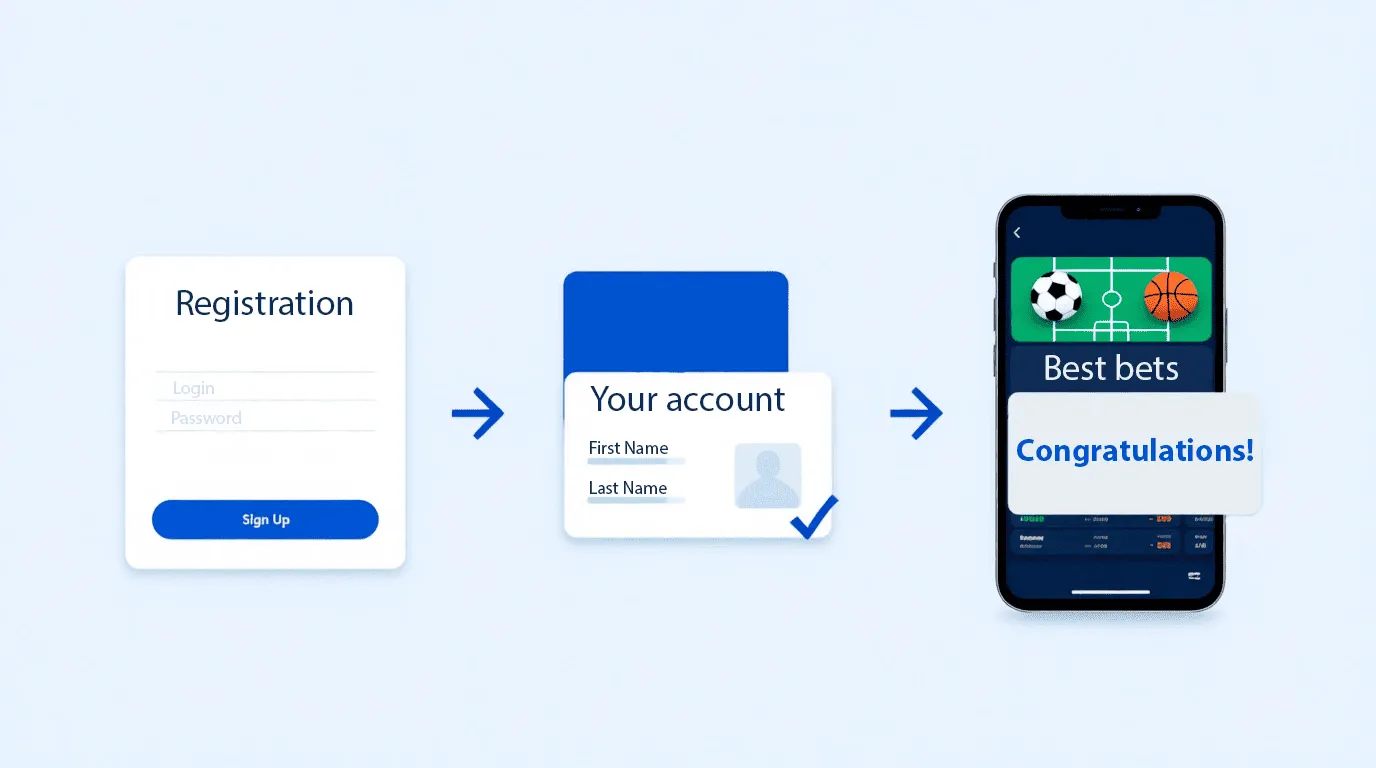
Complete account setup process from registration to first bet placement
Creating an account shouldn't feel like applying for a mortgage, but regulations mean there's some paperwork
involved. The registration process starts with basic information: name, email, date of birth, address. Nothing
unusual here, though it can feel invasive if you're privacy-conscious. Unfortunately, there's no way around it.
Licensed platforms must verify users for legal and security reasons.
Once you've entered your details, you'll receive a verification email. Click the link, confirm your account, and
you're past the first hurdle. Some platforms let you explore before verifying your identity, others lock
everything until you complete the full process. Patience here pays off, even if you're eager to start betting.
Identity Verification Requirements
Identity verification comes next, and this is where many people get frustrated. You'll need to upload a
government-issued ID, typically a driver's license or passport. Some platforms also require proof of
address, like a recent utility bill or bank statement. Yes, it's tedious. Yes, it feels excessive. But it's
not optional, and fighting it only delays your access.
The verification process usually takes between a few hours and a couple of days. During peak sign-up periods, it
might stretch longer. While you wait, you can familiarize yourself with the interface, browse available markets,
and plan your initial betting strategy. This downtime is actually valuable, it prevents impulsive first bets
made without proper research.
First Deposit Tips: Making your first deposit is straightforward once verification clears.
Most platforms accept credit cards, debit cards, and e-wallets like PayPal or Skrill. Credit cards are the
fastest option, with deposits appearing instantly in most cases. Bank transfers take longer but work well
for larger amounts. E-wallets split the difference, offering quick processing with added privacy.
Minimum deposits typically range from ten to twenty dollars, though this varies by payment method. Credit cards
often have lower minimums than bank transfers. If you're just testing the waters, start small. There's no prize
for depositing more than you're comfortable losing, and you can always add funds later.
Once your account is funded, navigating to place your first bet is surprisingly intuitive. Sports are listed
along the left sidebar or in a top menu. Click your chosen sport, browse available games or matches, and click
the odds next to your preferred outcome. This adds the selection to your bet slip, usually displayed on the
right side of the screen or in a pop-up.
Enter your stake amount in the bet slip. The platform automatically calculates your potential winnings based on
the odds and stake. Double-check everything, because once you confirm the bet, it's locked in. Odds can change
between when you add a selection and when you confirm, so pay attention to any notifications about odds
movements.
Understanding Betting Odds the Smart Way
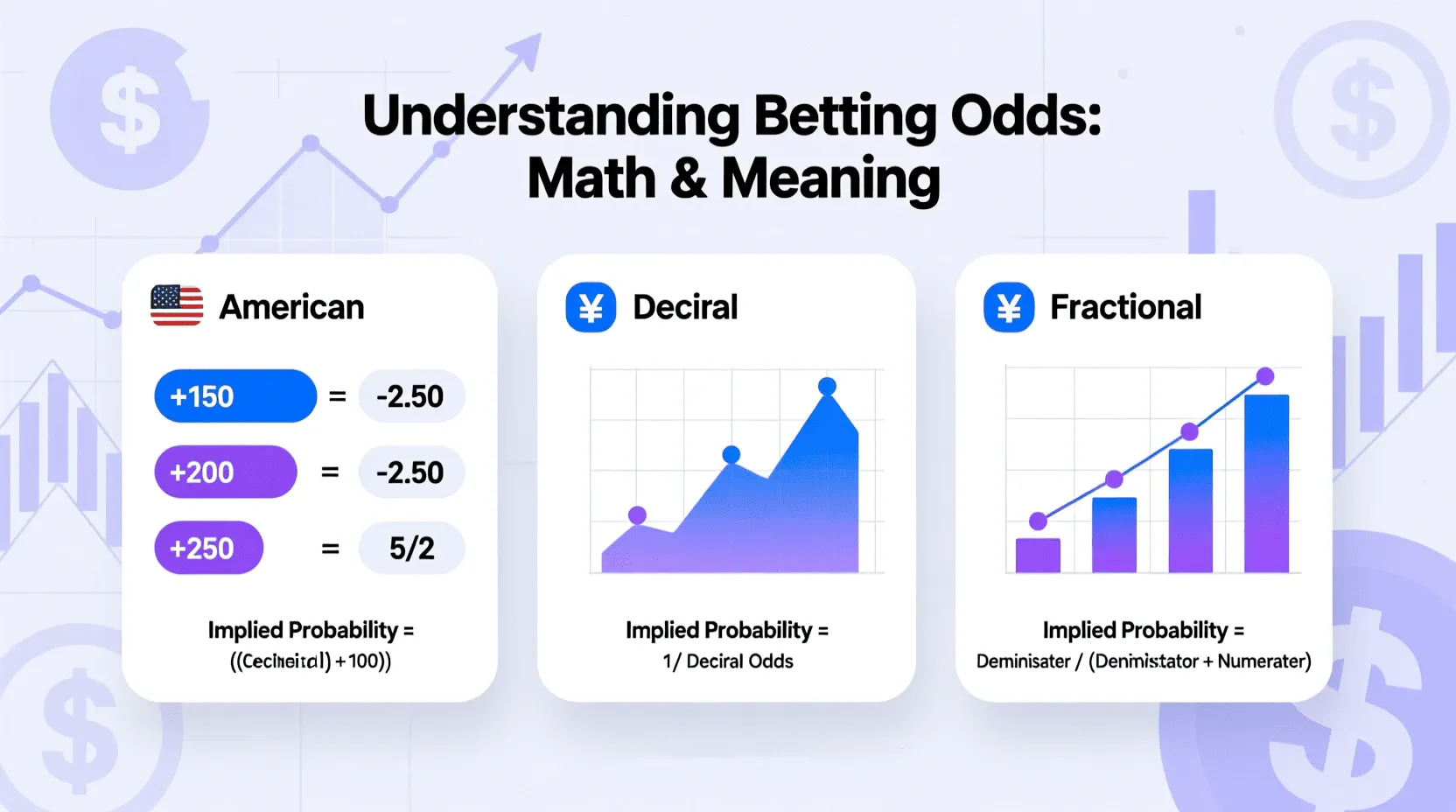
Visual guide to understanding different odds formats and implied probabilities
Odds are not predictions. They're prices, and like all prices, they reflect both the underlying value of what
you're buying and the market dynamics around it. When you see odds of plus-150, you're not seeing a sixty-seven
percent chance of something happening. You're seeing a price that, if the actual probability is higher than
what's implied, represents value.
American odds dominate most US-based platforms, though you'll see decimal and fractional formats on international
sites. American odds use positive and negative numbers to show underdogs and favorites. Positive odds, like
plus-200, tell you how much profit you'd make on a hundred-dollar bet. So plus-200 returns two hundred dollars
in profit plus your original hundred-dollar stake, for a total payout of three hundred dollars.
Reading American Odds
Negative odds, like minus-150, tell you how much you need to bet to win one hundred dollars. At minus-150,
you'd need to risk one hundred fifty dollars to win one hundred. Your total payout would be two hundred
fifty dollars, the original stake plus winnings. This format feels backward at first, but you get used to
it.
The key to understanding odds is converting them to implied probability. For positive odds, divide one hundred by
the odds plus one hundred, then multiply by one hundred. For plus-200 odds, that's one hundred divided by three
hundred, which equals thirty-three-point-three percent. For negative odds, divide the absolute value of the odds
by itself plus one hundred, then multiply by one hundred. For minus-150, that's one hundred fifty divided by two
hundred fifty, which equals sixty percent.
The Vigorish: These implied probabilities don't reflect the true probability of an outcome.
They include the sportsbook's margin, also called the vigorish or vig. This is how bookmakers make money
regardless of the outcome. When you add up the implied probabilities of all possible outcomes in a betting
market, they total more than one hundred percent. That excess is the vig.
Understanding this changes how you evaluate bets. You're not just asking if a team will win, you're asking if
they'll win more often than the implied probability suggests. If you think a team has a forty percent chance of
winning but the odds imply only thirty-three percent, that's a value bet. Over many similar bets, this edge
compounds.
Decimal odds are more straightforward, they simply show your total return for every dollar wagered. Odds of
two-point-five mean you get two dollars and fifty cents back for every dollar bet, including your stake. To
convert decimal odds to implied probability, divide one hundred by the decimal odds. So two-point-five converts
to forty percent implied probability.
Real value comes from comparing your assessment of probability to the market's assessment. If you think something
is more likely than the odds suggest, you have an edge. If you think it's less likely, pass on the bet or look
at the other side. This is sports betting's fundamental skill, everything else is just tactics.
Most bettors never think about odds deeply enough. They see minus-110 and think it's basically fifty-fifty. But
minus-110 implies a fifty-two-point-four percent chance, meaning you need to win more than half your bets just
to break even. That two-point-four percent edge is everything over the long run. Respect it.
Betting Markets: From Moneylines to Parlays
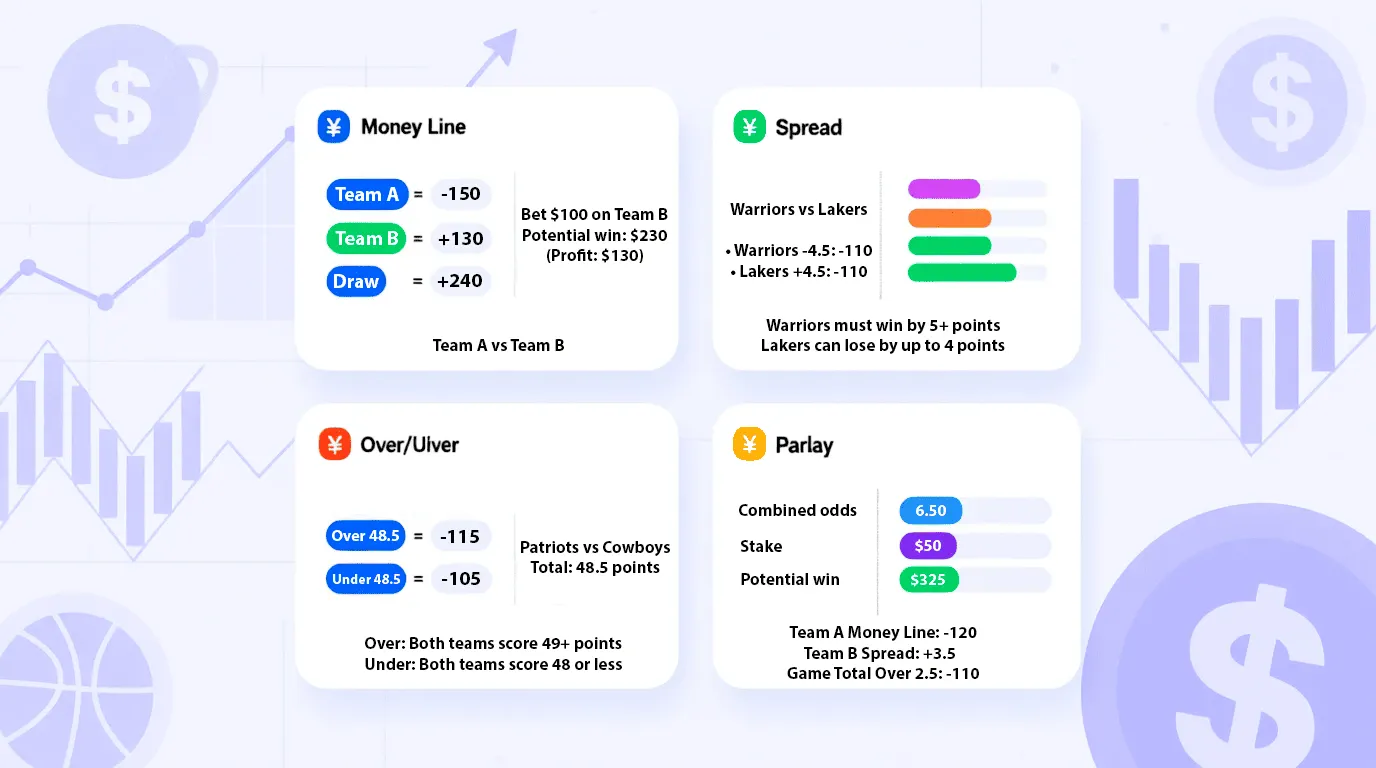
Comprehensive overview of available betting markets and their characteristics
Moneyline bets are the simplest form of sports wagering, you're picking who wins. No point spreads, no totals,
just straight-up winner selection. Favorites have negative odds, underdogs have positive odds, and your job is
to decide if the price is right. Moneylines work best when you have strong conviction about an outright winner
but less certainty about the margin of victory.
Point Spreads Explained
Point spreads level the playing field between mismatched opponents. The favorite must win by more than the
spread, while the underdog can lose by less than the spread or win outright and still cover. A seven-point
spread means the favorite needs to win by eight or more, while the underdog covers by losing by six or less
or winning the game. Spreads typically price at minus-110 on both sides, though this varies based on betting
action.
The spread betting strategy differs fundamentally from moneyline betting. You're no longer just handicapping who
wins, you're predicting the margin. This requires deeper analysis of team tendencies, pace of play, and
situational factors. A great team might be a bad bet against the spread if they tend to win close games, while
an inconsistent team might offer value if they lose big or win big with little middle ground.
Over-under betting, also called totals, asks you to predict whether the combined score of both teams exceeds or
falls short of a set number. Like spreads, totals typically price at minus-110 on both sides. The total adjusts
based on factors like weather, pace of play, and offensive efficiency. Over-under betting removes the question
of which team wins, you just need both teams collectively to score more or fewer points than projected.
Parlay Mathematics: Parlays combine multiple bets into one ticket, with all selections
needing to win for the parlay to cash. The appeal is obvious, small stakes can return large payouts. A
three-team parlay at standard odds pays about six-to-one, while a five-team parlay pays around
twenty-five-to-one. But here's the catch: parlays are sucker bets from a pure value perspective.
The math works against you. Each leg of a parlay needs to win, and the probability of multiple independent events
all occurring is their individual probabilities multiplied together. A three-team parlay where each leg has a
fifty-five percent chance of winning only succeeds sixteen-point-six percent of the time, yet it pays out like a
one-in-six shot. The house edge on parlays is enormous compared to straight bets.
Does this mean you should never bet parlays? Not necessarily. If you're betting for entertainment and want to
turn five dollars into a potential hundred-dollar payday, parlays serve that purpose. But don't fool yourself
into thinking they're a smart betting strategy. They're lottery tickets with better odds than actual lotteries,
which is damning with faint praise.
Prop Bets and Futures
Prop bets offer action on specific occurrences within games, independent of the final outcome. Will the
quarterback throw for over or under two hundred seventy-five yards? Will the first basket be a
three-pointer? Will the game go to overtime? Props range from skill-based to pure luck, and the odds reflect
this. Sharp props on player performance often offer value, while novelty props like coin toss results are
generally priced to heavily favor the house.
Futures bets involve season-long or tournament-long outcomes, like championship winners or division titles. These
tie up your money for extended periods and come with significant vig, but they let you take positions on
narratives before the market fully prices them in. Early-season futures can offer value if you correctly
anticipate team trajectories before the broader market catches on.
Platform Features That Actually Matter
Live betting transforms sports wagering from a pre-game prediction into an active, evolving process. Instead of
locking in your opinion hours before kickoff, you react to what's actually happening on the field. Momentum
shifts, injury developments, and strategic adjustments all create opportunities for bettors who can process
information quickly and identify when the live odds don't reflect the current game state.
The live betting interface updates odds in real-time, sometimes every few seconds during high-action moments.
This creates both opportunity and danger. Opportunity because you're betting with more information than pre-game
bettors had. Danger because the speed can lead to impulsive decisions without proper analysis. The best live
bettors wait for clear edges rather than betting constantly just because options are available.
Cash-Out Functionality
Cash-out functionality gives you control over active bets before events conclude. If your bet is winning and
you want to secure profit rather than risk a late-game collapse, cash out. If your bet is losing but you
want to cut losses before it gets worse, cash out at a reduced loss. The platform calculates cash-out offers
based on current odds, and these offers fluctuate as game situations change.
Cash-out offers never give you full value compared to betting both sides independently. The platform builds in a
margin, effectively charging you for the convenience of not having to place a hedge bet manually. Sometimes this
convenience is worth it, especially when odds are moving fast or when you lack the bankroll to tie up more money
in hedge positions. Other times, you're better off letting your original bet ride or placing a separate hedge
bet if you can find better odds elsewhere.
Bet Builders: Bet builders let you create custom parlays within single games, combining
multiple outcomes into one bet. Want to bet on a football team to win, their quarterback to throw over
one-point-five touchdown passes, and the total to go over forty-two-point-five points? Bet builders make
this possible. They're entertaining and can be profitable if you've identified correlated outcomes that the
market hasn't properly priced together.
The correlation factor matters enormously with bet builders. If a quarterback throws multiple touchdowns, his
team is more likely to win and the total is more likely to go over. These outcomes aren't independent, and the
platform's pricing doesn't always fully account for positive correlations. Negative correlations work too, if
you expect a defensive slugfest with a low total, you might avoid betting favorites to cover big spreads in that
same game.
Statistics and data integration separate modern platforms from their predecessors. Advanced stats, historical
trends, and real-time game data inform your betting decisions if you know how to use them. Platforms that
provide robust statistical resources give you tools to make smarter bets, though remember that everyone else has
access to the same information. Your edge comes from interpreting data better, not just having access to it.
Promotions and Boosts
Odds boosts and promotions deserve skepticism. Yes, getting enhanced odds on a bet sounds great, but often
the base odds were already worse than other platforms, or the boost applies to lower-probability parlays
designed to lose. Genuine promotions exist, like bonus bets for new users or loss-back offers, but read the
terms carefully. Wagering requirements, odds restrictions, and expiration dates can turn an apparent gift
into a obligation.
The platform's mobile experience increasingly matters more than desktop functionality. Most betting happens on
phones now, whether you're at home on the couch, at the game itself, or killing time at work. A clunky mobile
interface frustrates users and leads to mistakes. A smooth mobile experience makes betting seamless, perhaps too
seamless if you're prone to impulsive wagering.
Brom Bet Toolkit
Three tools from this guide: compare cash-out against a DIY hedge, self-check the warning signs, and plan your first deposit.
The guide is explicit that cash-out builds in a margin compared to hedging manually. This compares the platform's flat offer against what a DIY hedge at the best available opposing odds would guarantee instead.
These are the exact warning signs this guide lists. This is a private self-check, not a diagnosis — nothing here is stored or sent anywhere.
Based on the typical ranges this guide describes for identity verification and first deposits. Actual figures vary by platform and can stretch longer during peak sign-up periods.
This tool applies information from this guide for general and educational purposes only — it is not financial or betting advice. Always gamble responsibly and within your means. If you or someone you know has a gambling problem, seek help immediately.
Winning Strategies That Work
Value betting is the only long-term profitable approach, and it's conceptually simple while being practically
difficult. You're looking for situations where your assessment of probability diverges from the market's implied
probability. If you think an outcome has a fifty percent chance of occurring but the odds imply only forty
percent, that's a value bet regardless of whether this particular bet wins or loses.
The challenge is that accurately assessing true probabilities is hard. It requires deep knowledge of the sport,
the teams, the situational factors, and the statistical models that project outcomes. Most bettors overestimate
their ability to assess probability, leading them to perceive value where none exists. Humility about your
actual edge is crucial.
Line Shopping Excellence
Line shopping means comparing odds across multiple sportsbooks to find the best price for your bet.
Half-point differences in spreads or five-cent differences in odds seem trivial on individual bets, but they
compound dramatically over hundreds of bets. Getting minus-105 instead of minus-110 consistently improves
your long-term returns by several percentage points, which is often the difference between winning and
losing.
The effort required for line shopping increases with the number of platforms you use. Managing accounts across
five or six sportsbooks takes time and organizational discipline. But if you're serious about profitable betting
rather than casual entertainment, it's non-negotiable. Sharps don't ignore five-cent edges, and neither should
you.
Timing your bets strategically impacts your results. Early betting gets you the opening lines before sharp money
moves them, potentially offering value if you've identified something the oddsmakers missed. Late betting gives
you maximum information about injuries, weather, and other factors, but you're getting odds that have been
hammered into efficiency by days of betting action. Neither approach is universally better, it depends on where
your edge lies.
Sport-Specific Approaches: Sport-specific strategies matter because different sports require
different analytical approaches. Baseball betting rewards understanding of pitcher matchups and bullpen
depth. Basketball betting requires analyzing pace, defensive schemes, and rest patterns. Football betting
demands knowledge of offensive line play, coaching tendencies, and weather impacts. You don't need to be an
expert in every sport, focusing on one or two lets you develop genuine expertise rather than surface-level
knowledge across many.
Record-keeping separates serious bettors from gamblers. Track every bet with the date, sport, type of bet, odds,
stake, result, and any notes about your reasoning. This creates a database that reveals your profitable patterns
and losing tendencies. Maybe you're excellent at totals but terrible at spreads. Maybe you win consistently on
home underdogs but lose on road favorites. Without records, you're flying blind.
Managing Your Bankroll Like a Pro
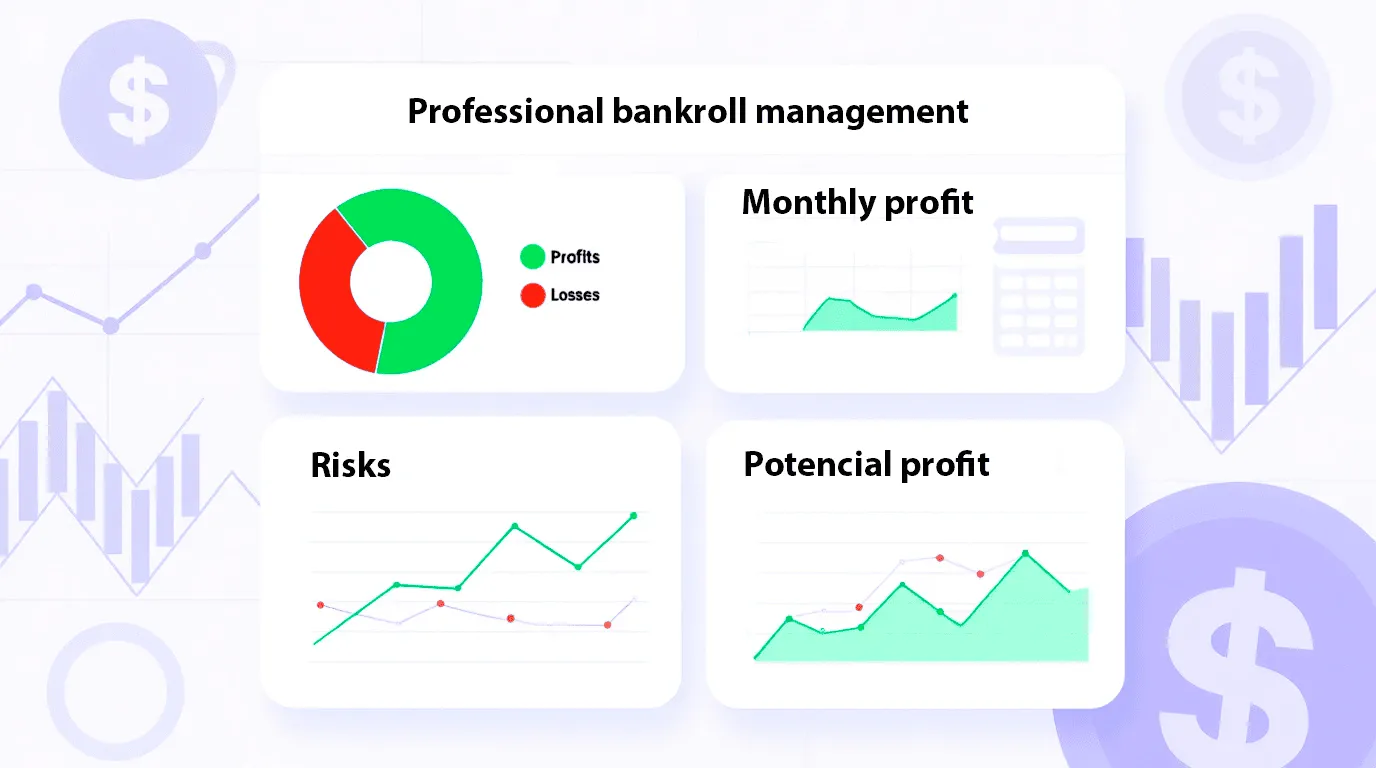
Effective bankroll management visualization with risk indicators and performance
tracking
Bankroll management might be the least sexy topic in sports betting, but it's arguably the most important. You
can be the world's best handicapper and still go broke with poor money management. The goal is surviving
variance long enough for your edge to manifest in profits, and survival requires discipline.
Your betting bankroll should be money you can afford to lose completely without impacting your quality of life.
This isn't your rent money, your car payment, or your kid's college fund. It's disposable income allocated
specifically for betting, completely separate from your regular finances. If losing your entire bankroll would
cause financial hardship, you're already doing this wrong.
Unit Sizing Strategy
Unit sizing determines how much you bet on each individual wager. Conservative bettors use one percent of
their bankroll per bet, moderate bettors use two to three percent, and aggressive bettors use four to five
percent. The higher your unit size, the greater your potential returns but also the higher your risk of ruin
during losing streaks. Most successful bettors stick to one to three percent, with smaller percentages on
speculative plays and larger percentages only on the strongest convictions.
The one-to-five percent rule provides a framework, but it's not rigid. A flat one percent on everything is safe
but might be too conservative if you've identified a truly exceptional edge. Varying your unit size based on
confidence makes sense, but it requires honest self-assessment. Most bettors overrate their strongest
convictions, leading to oversized bets that devastate bankrolls when they lose.
Variance Reality: Variance is the enemy and the reason bankroll management matters. Even
with a genuine edge, you'll experience losing streaks. A bettor who wins fifty-five percent of their bets at
minus-110 odds has a solid edge, but they'll still lose ten bets in a row multiple times over a season-long
sample. If your unit sizing is too aggressive, one bad run eliminates your bankroll before you can profit
from your edge.
Never chase losses by increasing bet sizes. This is the fastest path to ruin. When you're running bad, the
correct response is either maintaining your normal unit size or temporarily reducing it while you reassess your
process. Increasing bets during losing streaks turns manageable downswings into catastrophic losses.
Tracking your bankroll with a spreadsheet or betting app shows your trajectory over time. Record your starting
bankroll, every bet placed, and your current bankroll after each bet. This creates a visual representation of
your betting performance and helps identify when you're deviating from your plan. Seeing your bankroll grow over
weeks and months provides motivation, while seeing it shrink prompts strategy reassessment.
Professional Mindset
Professional bettors treat their bankroll like a business treats capital. They're not playing with money,
they're investing it with the goal of long-term growth. This mindset shift matters because it changes how
you make decisions. You stop betting for entertainment and start betting only when you have an edge. This
doesn't mean betting becomes boring, but it does mean betting becomes purposeful.
Setting stop-loss limits for sessions or days prevents emotional spirals. If you've lost five percent of your
bankroll in a day, maybe that's enough action for now. Taking a break lets emotions settle and prevents the
tilt-induced bets that compound losses. Stop-loss limits feel restrictive, but they're guard rails that keep you
on the road when variance tries to throw you off.
Mobile Betting: The Full Experience
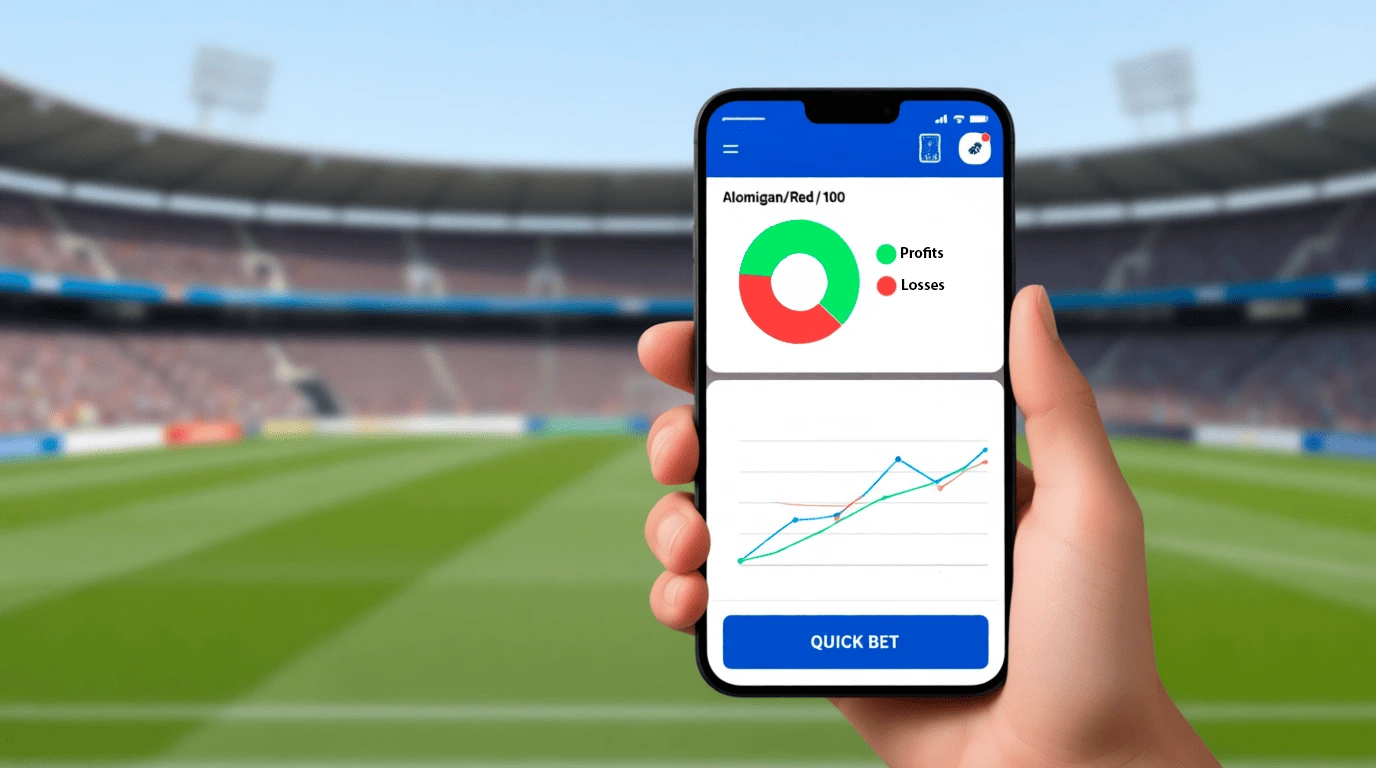
Modern mobile betting experience with real-time updates and intuitive navigation
Mobile betting has evolved from a convenience feature to the primary way most people interact with sportsbooks.
Your phone is always with you, always connected, and always ready to let you bet on whatever's happening right
now. This accessibility is powerful, but it also enables impulsive betting that desktop users might avoid.
The decision between using a dedicated app versus the mobile website depends on your priorities. Apps typically
offer smoother performance, faster loading times, and better integration with your phone's features like
notifications and biometric login. Mobile websites require no download, take up no storage space, and work
across any device with a browser. Both approaches work fine, though serious bettors usually prefer apps for the
enhanced experience.
Mobile App Setup
Getting started with the mobile app involves downloading from your device's app store, though some platforms
require downloading directly from their website to avoid app store gambling restrictions. Installation is
straightforward, though you'll need to enable installation from unknown sources on Android devices if
downloading outside the Google Play Store. First-time setup mirrors the desktop experience: log in with your
credentials, set up biometric authentication if desired, and configure notification preferences.
The mobile interface prioritizes quick bet placement over comprehensive information. Sports are typically
accessed through a bottom navigation bar or hamburger menu. Tap a sport, browse games, tap odds, and your bet
slip appears. The condensed interface means less information visible simultaneously, which can be a feature or a
bug depending on your betting style. If you need extensive research and statistics, desktop might be better for
analysis with mobile reserved for execution.
Live betting on mobile is where the platform really shines. You're watching a game on TV, you notice a momentum
shift the odds haven't caught up with yet, you pull out your phone and bet in seconds. This immediacy creates
opportunities that don't exist for desktop users who need to walk to their computer. But it also creates
temptation to bet constantly just because you can.
Push Notifications: Push notifications keep you updated on bet results, promotional offers,
and odds changes on games you've favorited. These notifications are useful for tracking active bets without
constantly opening the app. But they're also designed to pull you back into the app frequently, increasing
engagement and betting frequency. Customize notification settings to show what you actually need rather than
accepting the defaults optimized for platform engagement.
Security on mobile requires attention. Biometric login via fingerprint or face recognition adds convenience while
maintaining security better than typing passwords on a small screen. Always use biometrics if available. Public
WiFi networks pose security risks when accessing betting accounts or making financial transactions. Use cellular
data or a VPN when betting from coffee shops, airports, or other public spaces.
Data usage becomes relevant if you're on a limited mobile plan. Live betting with streaming video consumes
significant data, potentially hundreds of megabytes per hour. Live betting without video uses far less, mostly
just refreshing odds and updating bet slips. Static pre-game betting uses minimal data. Monitor your usage and
adjust behavior if you're approaching plan limits.
Battery and Strategy Considerations
Battery drain is the hidden cost of mobile betting. Apps running in the background, constant connectivity,
screen-on time, and GPS features all consume battery. Live betting sessions can drain twenty to thirty
percent of your battery in an hour. Keep a charger handy if you're planning extended mobile betting
sessions, especially if you're at a venue watching live sports and betting simultaneously.
The mobile betting strategy differs from desktop strategy primarily in terms of preparation. On desktop, you can
have multiple browser tabs open comparing odds, analyzing stats, and researching bets. On mobile, this
multitasking is clunkier. The solution is doing your research and line shopping before you need to bet, then
using mobile for quick execution when opportunities arise.
Security, Safety, and Responsible Gambling
Platform security determines whether your money and personal information stay safe. Licensed sportsbooks use
encryption protocols to protect data transmission between your device and their servers. Look for https in the
URL and security badges on the site. These are baseline requirements, not special features. Any platform lacking
them should be avoided entirely.
Account security starts with a strong, unique password that you don't use anywhere else. Password managers make
this easier by generating and storing complex passwords. Enable two-factor authentication if the platform offers
it. This adds a second verification step when logging in, typically a code sent to your phone or generated by an
authenticator app. It's a minor inconvenience that significantly improves security.
Financial Information Protection
Financial information security means your payment details are encrypted and tokenized rather than stored in
raw form. Reputable platforms never store complete credit card numbers or banking details. They use
tokenized references that are useless to hackers even if breached. But this protection only matters if
you're using legitimate platforms. Unlicensed or sketchy sportsbooks might not implement proper security,
putting your financial information at risk.
Licensing and regulation provide oversight that protects users. Licensed platforms must meet financial stability
requirements, maintain segregated player funds, and submit to regular audits. They're accountable to regulatory
bodies that can penalize or shut them down for violations. This doesn't guarantee perfect behavior, but it
creates consequences for misconduct that unlicensed operators don't face.
Responsible Gambling Tools: Responsible gambling tools exist because betting can become
problematic. Deposit limits let you cap how much money you can add to your account daily, weekly, or
monthly. Betting limits restrict your wager amounts. Time limits notify you when you've been actively
betting for a certain duration. Reality checks periodically display your total wagering and time spent. Loss
limits stop you from losing more than a preset amount in a given timeframe.
These tools work only if you actually use them and set them at meaningful levels. Setting a thousand-dollar
monthly deposit limit when you never deposit more than two hundred accomplishes nothing. Set limits that
actually constrain your behavior, that create friction when you're tempted to bet more than you should. The
point is protection from your worst impulses, not creating the illusion of control while changing nothing.
Self-exclusion is the nuclear option when betting has become a problem you can't manage with lesser measures.
Self-exclusion blocks your access to the platform for a period you choose, typically ranging from six months to
permanent. You can't log in, you can't deposit, you can't bet. Some jurisdictions offer cross-platform
self-exclusion that blocks you from all licensed operators, not just one.
Recognizing Problem Gambling
The decision to self-exclude is difficult because it means admitting you've lost control. But it's far better
to self-exclude proactively than to continue betting destructively until you've suffered financial or
personal catastrophe. If you're spending money you can't afford to lose, hiding your betting from family,
borrowing money to cover losses, or feeling unable to stop, self-exclusion might be necessary.
Warning signs of problem gambling include betting with money needed for essential expenses, lying about betting
activities, chasing losses compulsively, betting to escape problems or negative feelings, neglecting work or
relationships due to betting, and feeling unable to stop despite wanting to. Not everyone who bets develops
problems, but everyone who bets should monitor for these signs in themselves.
The reality is that sports betting companies profit when users lose money, and while responsible gambling tools
are required by regulators, they work against the platform's financial interests. Use the tools anyway. Set
limits that protect you. And if betting stops being entertainment and becomes a problem, take action before the
problem takes everything.
Frequently Asked Questions
How does sports betting work on Brom Bet?
Sports betting on Brom Bet operates through a straightforward process of selecting outcomes and placing
wagers. You choose a sport and event, pick from available betting markets like moneylines, spreads, or
totals, decide your stake amount, and confirm your bet. The platform sets odds that reflect both the
probability of outcomes and the built-in house margin. If your prediction is correct, you receive your
stake back plus winnings calculated from the odds. If wrong, you lose your stake. The platform profits
from the margin built into odds across all bets, ensuring profitability regardless of individual
outcomes. Live betting adds real-time wagering during events, while features like cash-out let you
settle bets before events conclude. Understanding that odds represent prices rather than pure
probabilities helps you identify value bets where the market's assessment differs from your own, which
is the foundation of profitable betting over time.
Is Brom Bet safe and legitimate for online betting?
Brom Bet operates as a licensed sportsbook subject to regulatory oversight, which provides baseline
safety protections that unlicensed platforms lack. Licensed platforms must maintain financial stability,
keep player funds segregated from operating capital, and submit to regular audits. Security measures
include encryption for data transmission, tokenized storage of payment information, and account
protection features like two-factor authentication. However, safety also depends on your own practices
like using strong passwords, enabling security features, and avoiding public WiFi for financial
transactions. Legitimacy means the platform follows established rules and pays out winnings as required,
though payout speed varies by payment method. User reviews and complaint records provide additional
insight into platform reliability. While no platform is perfectly safe, licensed and regulated
sportsbooks offer significantly better protection than unregulated alternatives, though you should
always bet only money you can afford to lose.
What's the minimum deposit required to start betting on Brom Bet?
Minimum deposit amounts typically range from ten to twenty-five dollars depending on your chosen payment
method. Credit and debit cards usually have lower minimums, often ten dollars, while bank transfers and
some e-wallets may require higher minimum deposits of twenty-five to fifty dollars. These minimums are
set by both the platform and payment processors, and they can vary during promotional periods when
platforms temporarily lower barriers to attract new users. Starting with a small deposit makes sense for
new bettors learning the platform and testing strategies without significant financial risk. You can
always add more funds later as you gain experience and confidence. Remember that your deposit becomes
your betting bankroll, and proper bankroll management suggests limiting individual bets to one to five
percent of your total funds. A fifty-dollar deposit shouldn't lead to ten-dollar bets if you're
following conservative bankroll principles, so consider depositing enough to make your desired bet
sizing practical while staying within your comfortable loss threshold.
Brom Bet Betting Guide Summary and How to Start Betting Successfully
Sports betting isn't gambling if you're doing it right. It's not luck when you consistently find value in
mispriced odds. It's not chance when your bankroll grows steadily over months despite inevitable losing streaks.
But it's also not a get-rich-quick scheme, and anyone selling you that fantasy is either delusional or
dishonest.
The path to profitable betting runs through education, discipline, and ruthless self-honesty. You need to
understand odds deeply, manage money carefully, and admit when you're betting on hope rather than edge. Most
people who bet sports lose money, not because the house is unbeatable, but because they beat themselves through
poor decisions and emotional wagering.
Remember: Start small, learn constantly, and respect the process. Your first hundred bets
are tuition, not profit opportunities. Track everything, identify your strengths and weaknesses, and adjust
accordingly. If betting stops being fun or starts causing financial stress, step back. There's no shame in
recreational betting for entertainment, but there's no glory in destructive betting that ruins finances.
The sportsbook will always be there tomorrow. The game will still be there next week. You don't need to bet
everything, you just need to bet smart when you have an edge. Everything else is just expensive entertainment.