
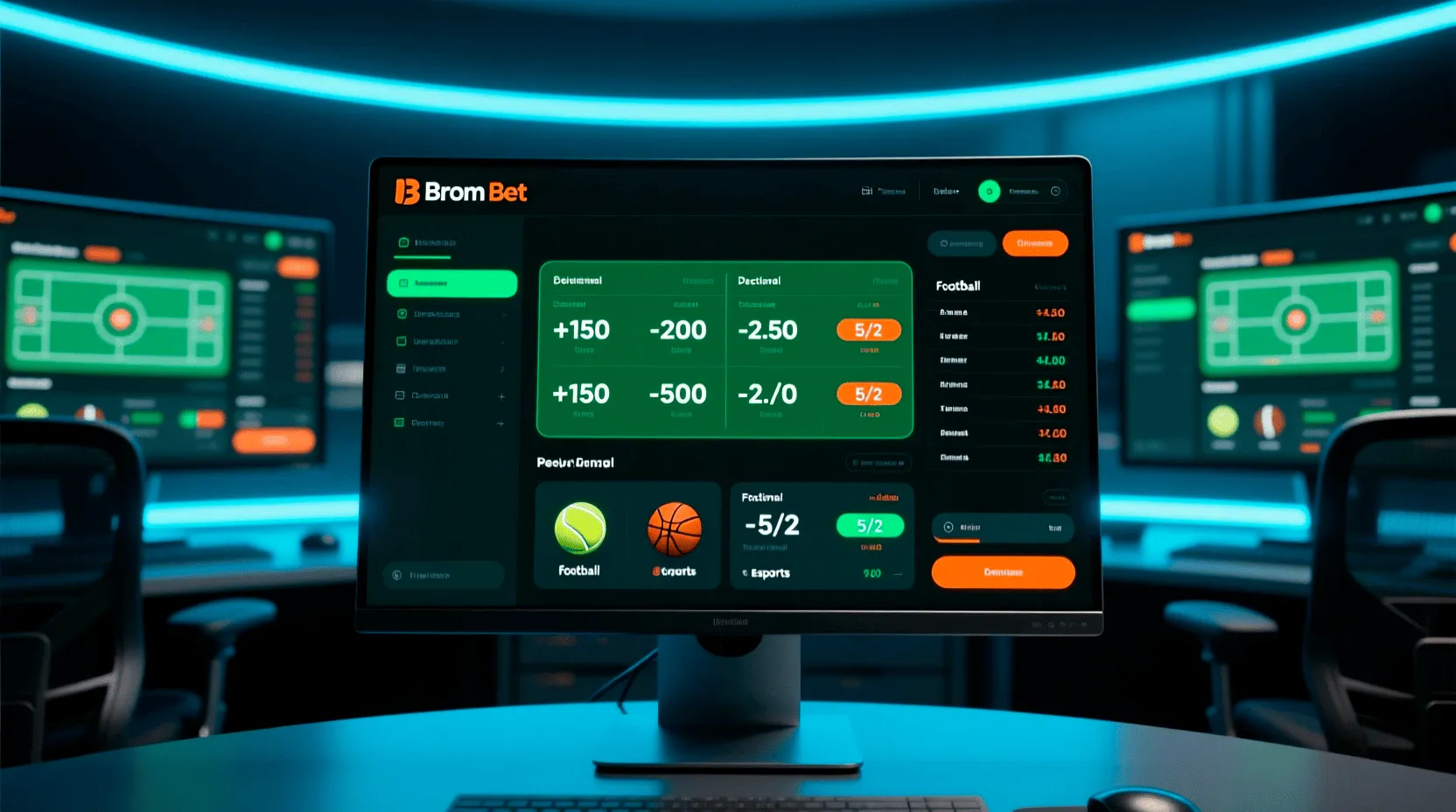
Staring at a betting screen for the first time feels like reading hieroglyphics. You see numbers with plus and minus signs, ratios that look like fractions, and decimal points in strange places. Your friend next to you is casually dropping phrases like “I got them at minus-110” or “that’s great value at plus-200,” and you’re nodding along while having absolutely no idea what any of it means.
Here’s what nobody tells you: odds aren’t complicated. They’re deliberately presented in ways that make them seem more complex than they actually are, because confusion benefits the house. Once you understand what those numbers actually represent, the fog lifts completely. You stop being someone who blindly clicks buttons hoping for the best, and you start being someone who can evaluate whether a bet is worth making.
This guide breaks down everything about reading odds on Brom Bet, from the basic mechanics to the advanced concepts that separate casual bettors from profitable ones. We’re not going to use complicated math formulas or academic language. Just straightforward explanations that actually make sense.
How to read betting odds on brom bet.
Why Understanding Odds Changes Everything
Most people treat betting odds like they’re predictions from some omniscient algorithm that knows exactly what’s going to happen. They see a team favored at minus-200 and think “oh, they’re definitely going to win.” That’s not how this works at all.
Odds are prices in a marketplace, nothing more. When you see odds on Brom Bet, you’re looking at the platform’s attempt to balance action on both sides while building in their profit margin. The odds shift based on how much money is coming in on each side, not because some computer in the basement suddenly calculated that the away team’s chances improved by three percent.
Understanding this fundamental truth changes your entire approach. You stop asking “who will win” and start asking “is this price worth paying.” Those are completely different questions, and the difference between them is everything.
The real-world impact of understanding odds shows up in your bankroll over time. Let’s say you’re betting minus-110 lines, which most people do without thinking. That implies you need to win 52.4 percent of your bets just to break even. Not fifty percent. Not “around half.” Specifically 52.4 percent. If you don’t know that, you’re flying blind. You might think you’re doing okay winning half your bets, not realizing you’re slowly bleeding money.
People who truly understand odds can identify when the market has mispriced something. Maybe public perception is skewed by recent headlines. Maybe sharp bettors haven’t moved the line yet. Maybe there’s information you have that the market doesn’t. These gaps create value, and value is the only thing that matters in betting.
The sportsbook doesn’t care if you win individual bets. They care about taking a percentage of the total action over time. When you understand odds deeply, you stop playing their game and start playing your own. You’re no longer a customer contributing to their profit margin. You’re someone hunting for situations where the price is wrong.
American Odds: The Complete Breakdown
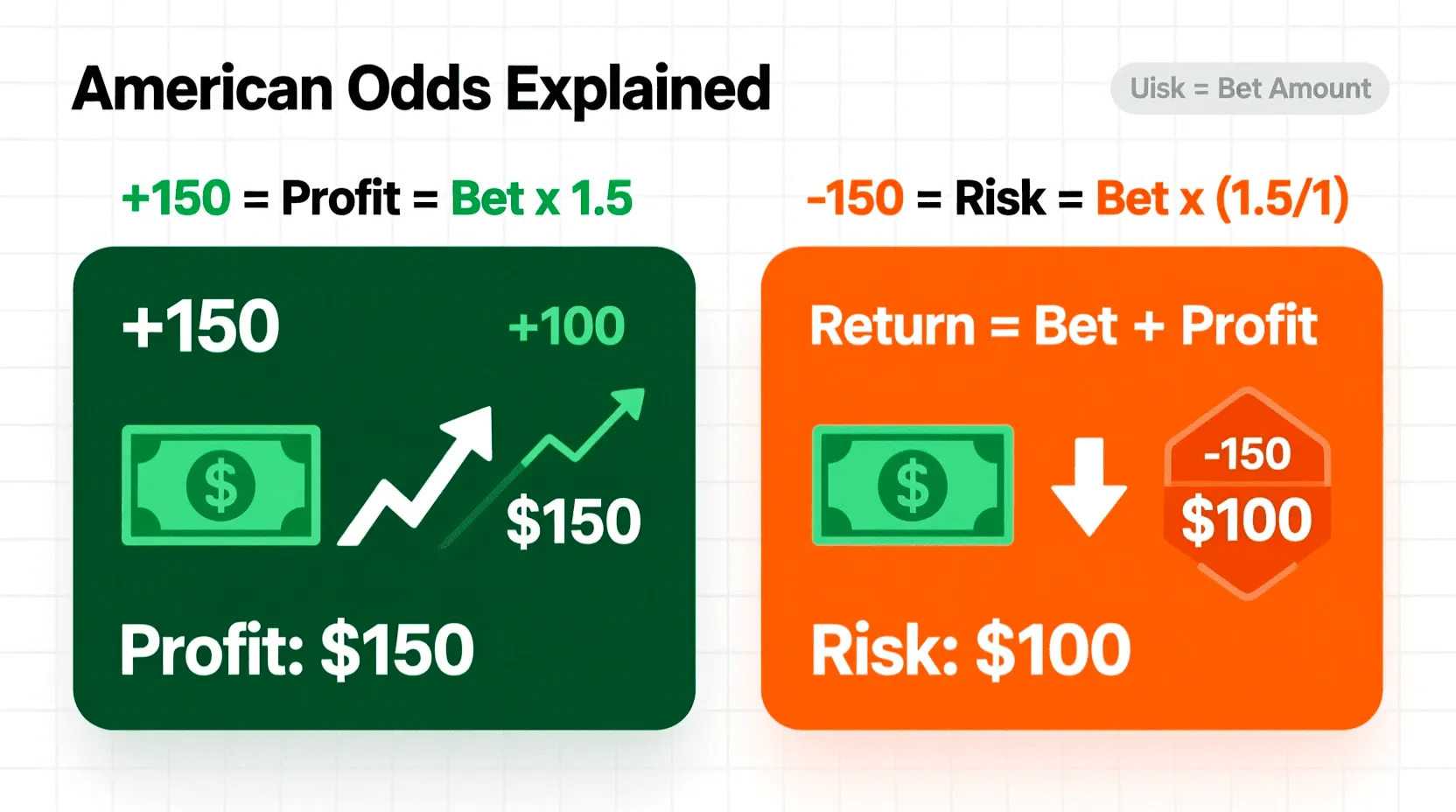
American odds dominate US-based platforms, and they work on a system of positive and negative numbers centered around one hundred dollars. This feels arbitrary at first, but once you internalize the logic, reading them becomes second nature.
Positive odds show how much profit you’d make on a one hundred dollar bet. If you see plus-150, that means betting one hundred dollars returns one hundred fifty dollars in profit, plus your original stake back. Your total payout would be two hundred fifty dollars. The higher the positive number, the bigger the underdog and the bigger your potential profit.
Think of positive odds as the market saying “we don’t think this outcome is likely, so we’ll pay you handsomely if you’re right.” Plus-200 is a bigger underdog than plus-150. Plus-500 is a massive underdog. Plus-1000 means you’re betting on something the market considers very unlikely, which is why it pays ten-to-one on your money.
Negative odds work differently and confuse more people. They show how much you need to bet to win one hundred dollars in profit. Minus-150 means you risk one hundred fifty dollars to win one hundred. Your total return would be two hundred fifty dollars, the same as the plus-150 example above, but you’re on the favorite side betting more to win less.
The lower the negative number goes, the bigger the favorite. Minus-200 is a bigger favorite than minus-150. Minus-500 is heavily favored. Minus-1000 means you’re betting on something the market considers almost certain, which is why you need to risk ten times your potential profit.
Here’s where it gets interesting. Notice that plus-150 and minus-150 aren’t exact opposites. If you bet one hundred dollars at plus-150, you could win one hundred fifty. But to win one hundred dollars at minus-150, you need to risk one hundred fifty. This asymmetry is part of how sportsbooks build in their edge.
Converting American odds to actual dollars is straightforward once you understand the format:
For positive odds, divide the odds by 100 and multiply by your stake
For negative odds, divide 100 by the absolute value of the odds and multiply by your stake
So if you’re betting fifty dollars at plus-200, that’s 200 divided by 100 equals 2, times 50 equals one hundred dollars profit. If you’re betting fifty dollars at minus-200, that’s 100 divided by 200 equals 0.5, times 50 equals twenty-five dollars profit.
The important thing to remember is that American odds always tell you the relationship between risk and reward. Positive numbers mean you’re risking less to win more. Negative numbers mean you’re risking more to win less. The magnitude tells you how much that imbalance tilts in either direction.
Most bettors never move past this surface understanding, and that’s exactly where the sportsbook wants you. They want you thinking in terms of favorites and underdogs, not in terms of implied probability and value. When you start thinking like that, you’re thinking like someone who’s paying the vig without realizing it.
Decimal and Fractional Odds Demystified
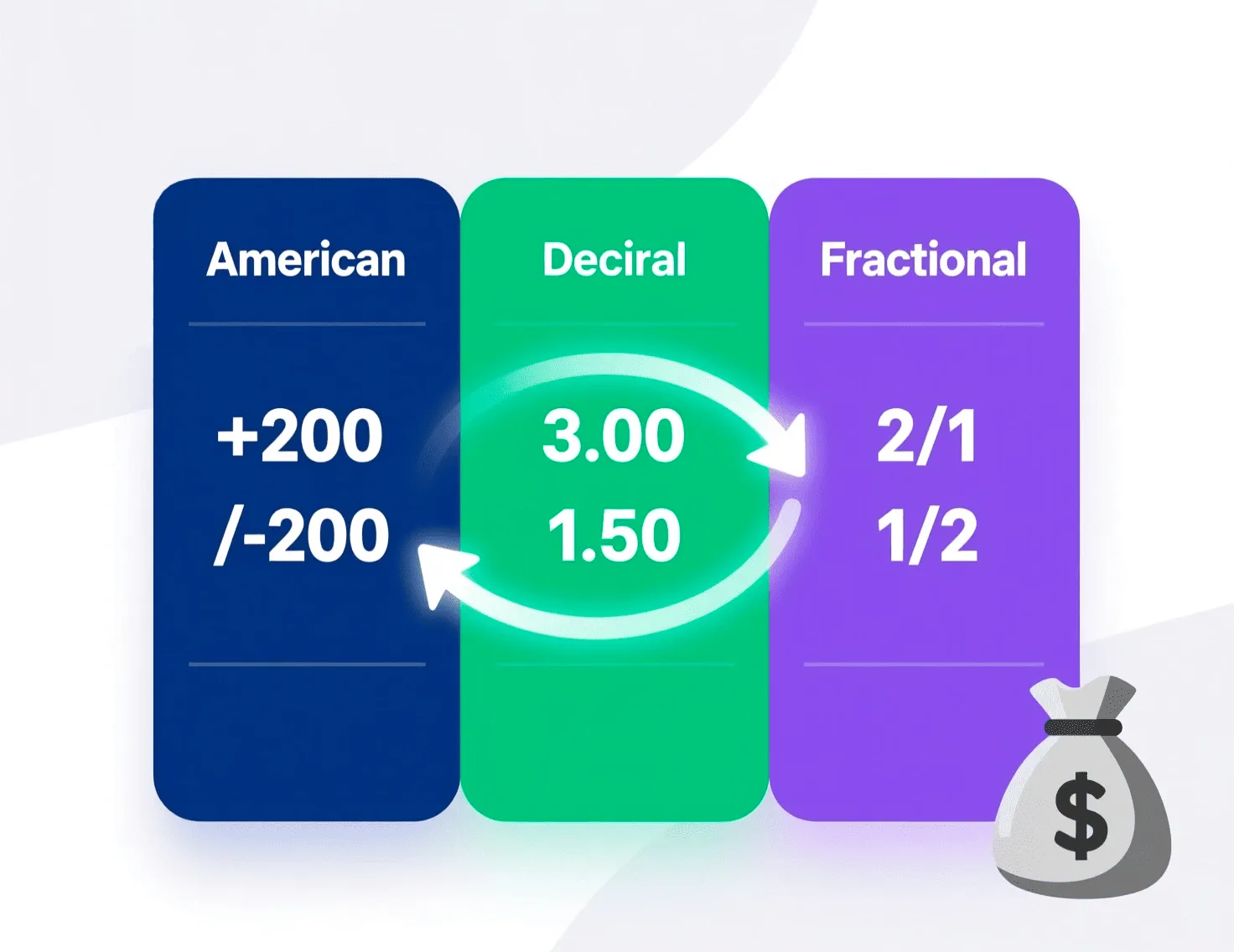
While American odds dominate US platforms, you’ll encounter decimal and fractional formats on international sites or when comparing odds across multiple books. Understanding these formats helps you shop for the best lines regardless of where you’re betting.
Decimal odds are mathematically cleaner and easier to work with. They simply show your total return for every dollar wagered, including your original stake. Odds of 2.50 mean you get two dollars and fifty cents back for every dollar bet. Odds of 3.00 mean you triple your money. Odds of 1.50 mean you get one dollar fifty back.
The beauty of decimal odds is that calculating your potential payout is trivial. Multiply your stake by the decimal odds and you’re done. Betting fifty dollars at 3.00 returns one hundred fifty dollars total. Betting twenty dollars at 1.75 returns thirty-five dollars total. No mental gymnastics required.
Converting between American and decimal odds takes one extra step but follows consistent rules:
Positive American odds become (odds divided by 100) plus 1 in decimal
Negative American odds become (100 divided by absolute odds) plus 1 in decimal
So plus-200 becomes 3.00 in decimal format. Minus-200 becomes 1.50 in decimal format. Once you see the pattern, the conversion becomes automatic.
Fractional odds are the traditional format from British bookmaking, and they show profit relative to stake as a ratio. Odds of 3/1 (read as “three to one”) mean you win three dollars for every one dollar bet. Odds of 5/2 mean you win five dollars for every two dollars bet. Odds of 1/2 mean you win one dollar for every two dollars bet.
Fractional odds immediately tell you whether you’re on a favorite or underdog. If the first number is bigger than the second, you’re on an underdog. If the second number is bigger than the first, you’re on a favorite. Even odds, written as 1/1 or sometimes “evens,” mean you double your money.
The challenge with fractional odds is calculating payouts for stakes that don’t match the denominator. If you’re betting fifty dollars at 7/2, you need to divide 50 by 2 to get 25, then multiply by 7 to get 175 dollars profit. It works, but it’s clunkier than decimal format.
Converting fractional to decimal is straightforward: divide the first number by the second and add 1. So 5/2 becomes 2.5 plus 1 equals 3.50 in decimal. Converting fractional to American requires checking whether the first or second number is bigger, then applying the appropriate formula.
The format you use matters less than understanding what all formats are actually telling you: the relationship between what you risk and what you win. Some people prefer American odds because they’re used to them. Some prefer decimal because the math is easier. Some prefer fractional because they learned betting in the UK. All three formats convey the same information, just packaged differently.
Smart bettors often keep a conversion chart handy when starting out, but after placing a few dozen bets, the conversions become intuitive. You stop thinking “what’s minus-110 in decimal” and just know it’s 1.91. You stop calculating “what’s 2.20 in American” and just know it’s plus-120. The format becomes irrelevant because you’re thinking in terms of value, not syntax.
Implied Probability: The Secret Weapon
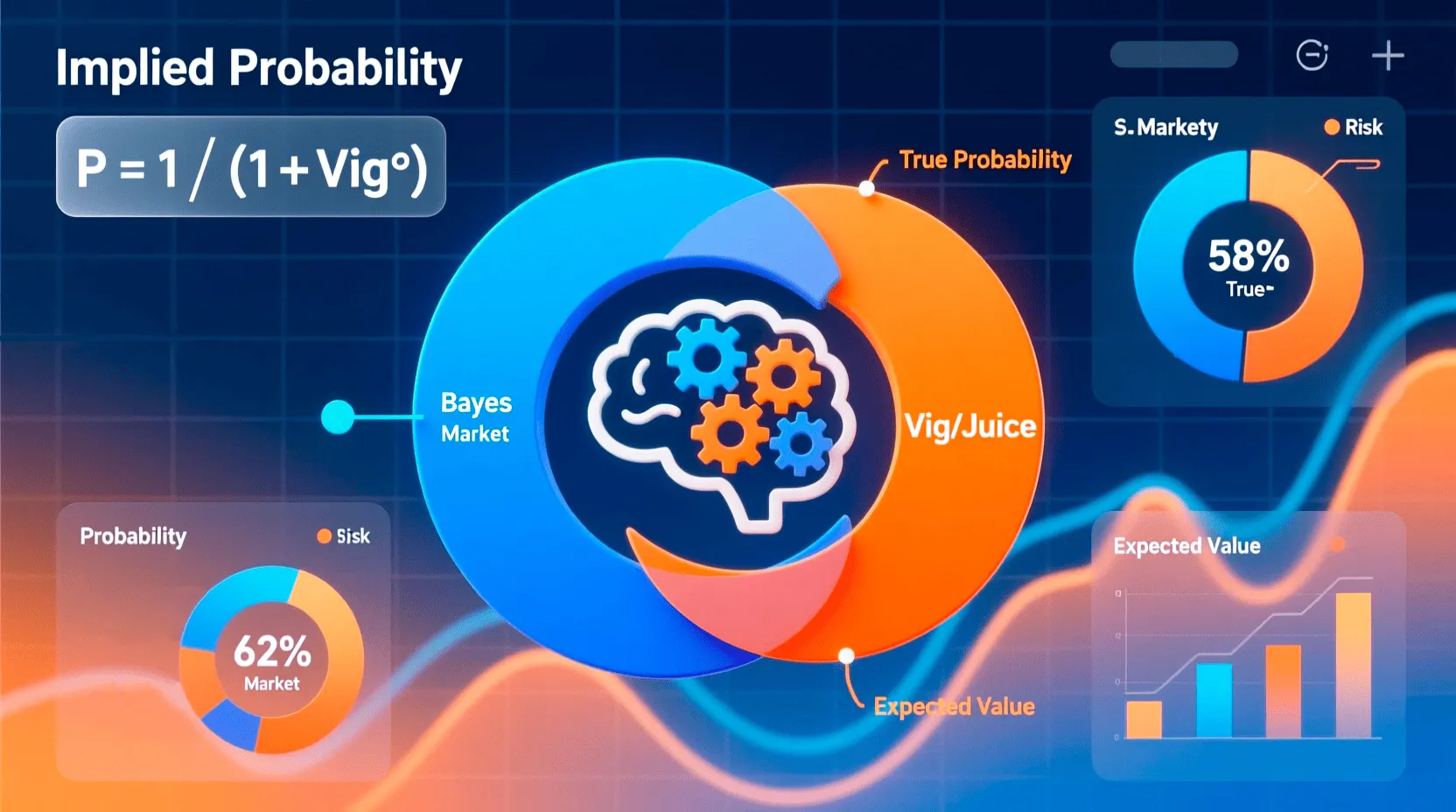
This is where casual bettors and serious bettors separate. Casual bettors look at odds and think about potential payouts. Serious bettors convert odds to implied probability and compare that to their own assessment of the true probability. This difference in approach is everything.
Implied probability is the market’s assessment of how likely an outcome is to occur, expressed as a percentage. When you see odds on Brom Bet, those odds contain an embedded probability statement. Minus-150 doesn’t just mean “this is the favorite.” It means the market implies this outcome has a certain percentage chance of happening.
The conversion formulas are simple:
For positive American odds: 100 divided by (odds plus 100), times 100 For negative American odds: absolute value of odds divided by (absolute odds plus 100), times 100
Let’s work through examples. Plus-200 converts to 100 divided by 300, which equals 0.333, times 100 equals 33.3 percent implied probability. The market is pricing this outcome as if it has a one-in-three chance of occurring.
Minus-150 converts to 150 divided by 250, which equals 0.6, times 100 equals 60 percent implied probability. The market is pricing this outcome as if it has a three-in-five chance of occurring.
Here’s the critical insight: these implied probabilities don’t reflect the true probability. They include the sportsbook’s margin, the built-in edge that ensures their profitability. This is why when you add up the implied probabilities of all possible outcomes in a two-way market, they sum to more than one hundred percent.
Take a simple coin flip bet. True probability is fifty percent for heads, fifty percent for tails, which sums to one hundred percent. But the sportsbook might offer minus-110 on both sides, which converts to 52.4 percent implied probability each. Add those together and you get 104.8 percent. That extra 4.8 percent is the vig, the juice, the sportsbook’s cut.
Understanding this changes how you evaluate bets completely. You’re no longer asking “what do the odds say.” You’re asking “what does the market think the probability is, and do I agree?” If you think an outcome has a 40 percent chance of occurring but the odds imply only 33 percent, you’ve found a value bet. If you think an outcome has a 55 percent chance but the odds imply 60 percent, you pass or look at the other side.
The gap between your assessment and the market’s assessment is your edge. No gap means no edge, which means no bet. A small gap might not be worth the risk. A large gap is where you want to put your money, assuming your assessment is more accurate than the market’s.
Most bettors never do this calculation. They see a team they like and bet on them without ever asking whether the price makes sense. This is like going to a store and buying something without checking if it’s on sale or overpriced. You’re just paying whatever the seller asks because you want the thing.
Professional bettors think in probabilities constantly. They maintain their own power ratings, track their prediction accuracy, and only bet when they identify a meaningful edge. This doesn’t mean they win every bet. It means they win often enough at good enough prices that they show long-term profit despite variance.
The discipline of converting odds to probability and comparing it to your assessment feels tedious at first. Eventually it becomes automatic. You see plus-180 and immediately think “36 percent implied, do I think it’s more likely than that?” The math disappears into intuition, but the foundation remains mathematical.
How Sportsbooks Set Their Odds
Understanding how odds are created demystifies the entire process and helps you identify when markets are inefficient. Sportsbooks don’t employ mystical oracles who divine the future. They use a combination of mathematical models, market forces, and risk management to set and adjust their lines.
The process starts with oddsmakers, often called traders, who use statistical models to project likely outcomes. These models incorporate historical data, team statistics, player performance metrics, situational factors, and countless other variables. For major sports like football and basketball, these models are sophisticated and accurate. For niche sports, they’re rougher and more exploitable.
The initial line isn’t meant to predict the exact outcome. It’s meant to split public opinion roughly down the middle so that the sportsbook gets balanced action on both sides. If they can achieve balance, they’re guaranteed profit from the vig regardless of who wins. This is the ideal scenario from their perspective.
Once the opening line is posted, the market takes over. Sharp bettors, those with genuine edges, place large wagers on sides they identify as mispriced. The sportsbook responds by moving the line to discourage further action on that side and encourage action on the other side. This is line movement, and it happens constantly leading up to game time.
Public perception also moves lines, sometimes dramatically. If a popular team is getting heavy betting action from casual bettors, the sportsbook might shade the line in that direction even if the sharp money suggests moving it the other way. They’re balancing mathematical accuracy with practical risk management.
Weather reports, injury news, and lineup changes all trigger line adjustments. A starting quarterback ruled out thirty minutes before kickoff sends odds into chaos as the market reprices everything. Bettors who react quickly to breaking news can sometimes get favorable prices before the market fully adjusts.
The vig, or vigorish, is built into odds from the start. Standard two-way markets price both sides at minus-110, which as we calculated earlier, implies 52.4 percent probability per side. That 4.8 percent overage is the sportsbook’s gross margin. After accounting for operational costs and occasional losses to sharp bettors, they’re left with their net profit.
Different bet types carry different vig amounts. Moneylines on heavy favorites often have reduced vig because the market is efficient and betting volume is high. Exotic prop bets might have massive vig because the market is inefficient and betting volume is low. The sportsbook charges more when they’re taking more risk or putting in more work to set accurate lines.
Line shopping across multiple sportsbooks works because different books use different models, cater to different customer bases, and manage risk differently. One book might offer minus-3 on a football spread while another offers minus-2.5. That half-point difference seems trivial but compounds dramatically over hundreds of bets.
Some sportsbooks follow the market leader, simply copying lines from the most respected books and adding their own vig on top. Others set their own lines independently, which can create opportunities for bettors who identify discrepancies. The books that copy are harder to beat because they’re piggybacking on sharper lines. The books that set their own lines are potentially more exploitable if you’re better at projecting outcomes than their oddsmakers.
Understanding this ecosystem helps you identify where to find the best prices and when to place your bets. Betting into the opening line sometimes offers value if you’ve spotted something the oddsmakers missed. Betting just before game time sometimes offers value if you have late-breaking information. Betting in the middle of the week often gets you the worst prices because that’s when the market is most efficient.
The sportsbook is not your opponent in the way a poker player is your opponent. They’re more like a broker facilitating a market between bettors with different opinions. Their goal is collecting transaction fees, not predicting winners. This is why truly sharp bettors can sustain profitability, they’re not beating the house, they’re finding mispriced opinions in the market and exploiting them.
Odds Comparison and Line Shopping

This might be the most impactful section of this guide for your actual results. Line shopping sounds tedious, and it is. But the difference between getting minus-105 versus minus-110 on every bet you place is enormous over time, potentially the difference between being a winning bettor and a losing one.
Here’s the math that proves it matters. Say you’re placing one hundred bets over a season, risking one hundred dollars each. You win exactly fifty-five of them, which is a solid winning percentage. At minus-110 odds, you’re betting 110 to win 100. Your fifty-five wins return fifty-five hundred dollars. Your forty-five losses cost forty-nine hundred fifty dollars. Net profit: five hundred fifty dollars, or a 5 percent return on the eleven thousand dollars you risked.
Now run the same scenario at minus-105 odds. You’re betting 105 to win 100. Your fifty-five wins return fifty-five hundred dollars. Your forty-five losses cost forty-seven hundred twenty-five dollars. Net profit: seven hundred seventy-five dollars, or about a 7.4 percent return. Same handicapping skill, same number of wins, 41 percent more profit just from getting better prices.
Scale that across hundreds or thousands of bets and you’re talking about real money. This is why serious bettors maintain accounts at multiple sportsbooks and check all of them before placing any bet. It’s not fun. It’s absolutely worth it.
Different sportsbooks cater to different audiences and manage risk differently, which creates price discrepancies. Brom Bet might have one line while competitors have slightly different ones. These differences are usually small, a few cents here or half a point there. Small edges compound into big edges.
Football spreads demonstrate this clearly. One book might have a team at minus-3 while another has minus-2.5. That hook (the half-point) is crucial. Tons of football games land on exactly three points. Getting minus-2.5 instead of minus-3 dramatically improves your chances of winning that bet. Savvy bettors specifically hunt for these key numbers, the threes and sevens in football where half-points swing outcomes.
Some sportsbooks shade their lines toward public perception more than others. Books catering to recreational bettors might move lines based on betting volume even when the sharp consensus disagrees. This creates opportunities where the “square” book has a worse line than the “sharp” book. Betting at the sharp book gets you the better price.
Timing your bets strategically becomes part of line shopping. Early in the week, you might find softer lines before sharp money has moved them. Close to game time, lines are sharper but you have more information. Neither approach is universally better, it depends on where your edge comes from.
Building a line shopping workflow doesn’t require fancy software. Open tabs for the sportsbooks where you have accounts. Check the odds for your intended bet at all of them. Place your bet where the price is best. The whole process takes two minutes and can make a meaningful difference to your bottom line.
The effort required scales with the number of accounts you maintain. Managing one or two books is easy. Managing six or seven requires organization, keeping track of balances, withdrawal policies, and promotional terms at each platform. Most serious bettors settle on three to five books as the sweet spot between price optimization and practical convenience.
Some sportsbooks limit or ban winning players, especially those who consistently exploit price discrepancies. This is their prerogative, though it’s frustrating when it happens. Having accounts at multiple books protects you when one decides they don’t want your action anymore.
Line shopping isn’t glamorous. It doesn’t involve clever insights or bold predictions. It’s just comparison shopping, the same thing you do when buying anything else. But in betting, that boring discipline of checking multiple prices before buying is often what separates winners from losers over the long haul.
Reading the Board and Understanding Movement
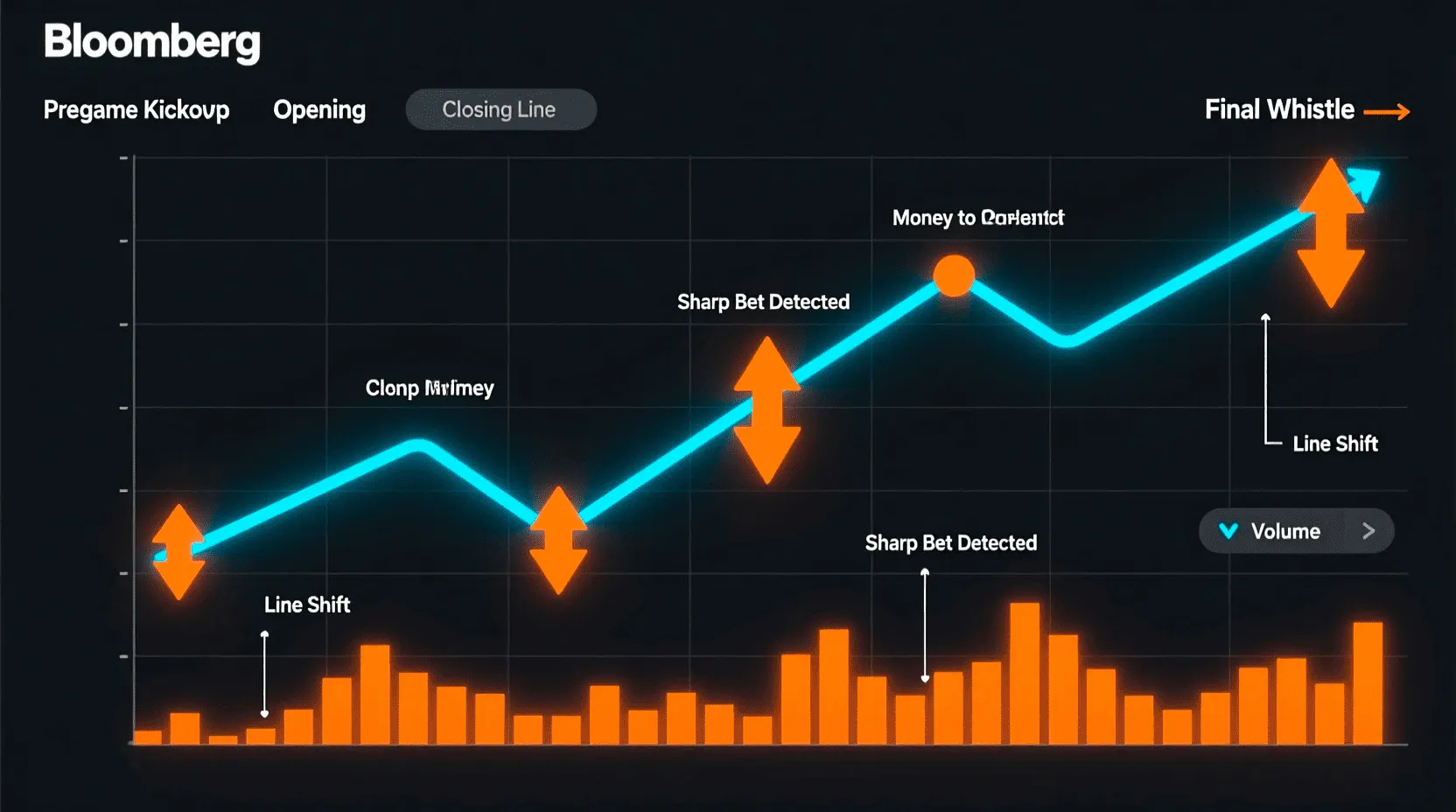
When you look at Brom Bet’s odds board, you’re not just seeing static numbers. You’re seeing a living market that reflects information flow, betting patterns, and collective wisdom. Learning to read this market helps you understand not just what the current price is, but why it is and where it might go.
Line movement happens for different reasons, and understanding those reasons helps you decide when to bet and which side to back. Sometimes a line moves because sharp bettors identified value and hammered one side. Sometimes it moves because breaking news changed the fundamental dynamics of the matchup. Sometimes it moves because the sportsbook is managing exposure to a popular public side.
Sharp money movement is what you want to identify and possibly follow. When professional bettors with proven track records place large wagers, sportsbooks respect that action and adjust lines accordingly. You can’t always tell which movement is sharp versus public, but you can look for clues. Large line moves on low betting volume suggest sharp action. Small line moves on high volume suggest public action that the book is comfortable taking.
Reverse line movement is particularly interesting. This is when the line moves opposite to where the public betting percentages suggest it should go. If seventy percent of bets are on Team A but the line moves to make Team B more attractive, that’s reverse line movement. It means the book is getting large sharp bets on Team B that outweigh the volume of small public bets on Team A.
Weather and injury updates move lines dramatically, especially in outdoor sports like football and baseball. A forecast changing from clear to rainy can shift totals by several points. A star player ruled out can move spreads by a touchdown or more. Being aware of breaking news and betting before the market fully adjusts sometimes offers value, though you’re competing with people who do this professionally with better information sources.
Some line movement is just noise, random fluctuation without meaningful information content. The line might tick up or down slightly as betting action flows in, but these small movements don’t necessarily indicate anything predictive. Distinguishing signal from noise requires experience watching markets over time.
Tracking line movement historically teaches you patterns. Maybe you notice that Sunday morning NFL lines consistently move toward the popular public teams, then reverse Saturday night as sharp money comes in. That pattern, if consistent, becomes exploitable. You wait until Saturday night to bet the unpopular side at an inflated price.
Opening lines versus closing lines tell you where the smart money landed. If a line opens at minus-3 and closes at minus-5, the market decided the favorite was underpriced initially. If it opens at minus-3 and closes at minus-1, the market decided the favorite was overpriced. The closing line is generally more efficient than the opening line because it incorporates all available information and betting activity.
Beating the closing line is a key metric for evaluating your betting skill. If you consistently get better numbers than where lines close, you’re likely a profitable bettor even if your short-term results show losses. If you consistently get worse numbers than closing lines, you’re probably losing money long-term even if you hit a lucky streak.
Some bettors use closing line value as their primary success metric, caring more about beating the close than about winning individual bets. This approach recognizes that variance affects short-term results but skill shows up in consistently getting better prices than the market’s final consensus.
Understanding line movement doesn’t mean you need to track every bet and every line shift obsessively. But having a general awareness of why lines move and what different types of movement might indicate helps you make better timing decisions and evaluate whether current prices offer value compared to where they might go.
The goal isn’t predicting line movement for its own sake. The goal is identifying situations where the current price doesn’t reflect your assessment of true probability, and taking advantage before the market corrects. Sometimes that means betting early. Sometimes it means waiting. The key is having a reason for your timing beyond random impulse.
Betting odds stop being mysterious the moment you understand what they actually represent. They’re not predictions. They’re not certainties. They’re prices in a market, set by algorithms and adjusted by human traders trying to balance action while protecting the sportsbook’s margin.
Your job as a bettor is evaluating whether those prices represent value compared to your own assessment of probability. When the market says something has a thirty-five percent chance but you think it has a forty-five percent chance, that ten-point gap is your edge. That’s where you make money over time, not by picking winners, but by identifying when the market has priced something incorrectly.
The formats—American, decimal, fractional—are just different languages saying the same thing. Learn to think in implied probability and value rather than getting caught up in the syntax of how odds are displayed. Master the conversion formulas until they become automatic, then forget about them because you’re thinking at a higher level.
Line shopping, tracking movement, understanding how sportsbooks set and adjust their odds—these aren’t advanced tactics for professionals only. They’re fundamental skills that every bettor should develop because they directly impact results. The difference between a casual bettor and a serious one isn’t handicapping ability. It’s often just these operational details executed consistently over time.
Most importantly, respect the math. The sportsbook builds in their edge through the vig, and that edge is real. You can overcome it with skill, but only if you’re honest about whether your edge exists. Converting odds to implied probability and comparing against your own assessment isn’t just useful, it’s the entire game. Everything else is noise.
See also the detailed odds guide.
