
Walking into the world of sports betting without understanding odds is like showing up to a poker game without knowing the rules. You might get lucky once or twice, but you’re essentially gambling blind. The numbers you see on a sportsbook aren’t random figures designed to confuse you, though it certainly feels that way at first. They’re a language, and once you speak it fluently, you’ll see betting opportunities where others see chaos.
Odds serve two fundamental purposes in sports betting. First, they tell you how much money you stand to win if your bet hits. Second, they reveal what the sportsbook believes is the probability of that outcome occurring. This second function is where the real value lies for serious bettors, but we’ll get there. For now, let’s decode the three major formats you’ll encounter across different sportsbooks and regions.
How to read odds on brom bet.
American Odds: The Plus and Minus System
American odds dominate sportsbooks in the United States, and they’re built around a simple baseline: $100. Every American odd tells you something about that hundred-dollar mark, though the relationship changes depending on whether you’re looking at a positive or negative number.
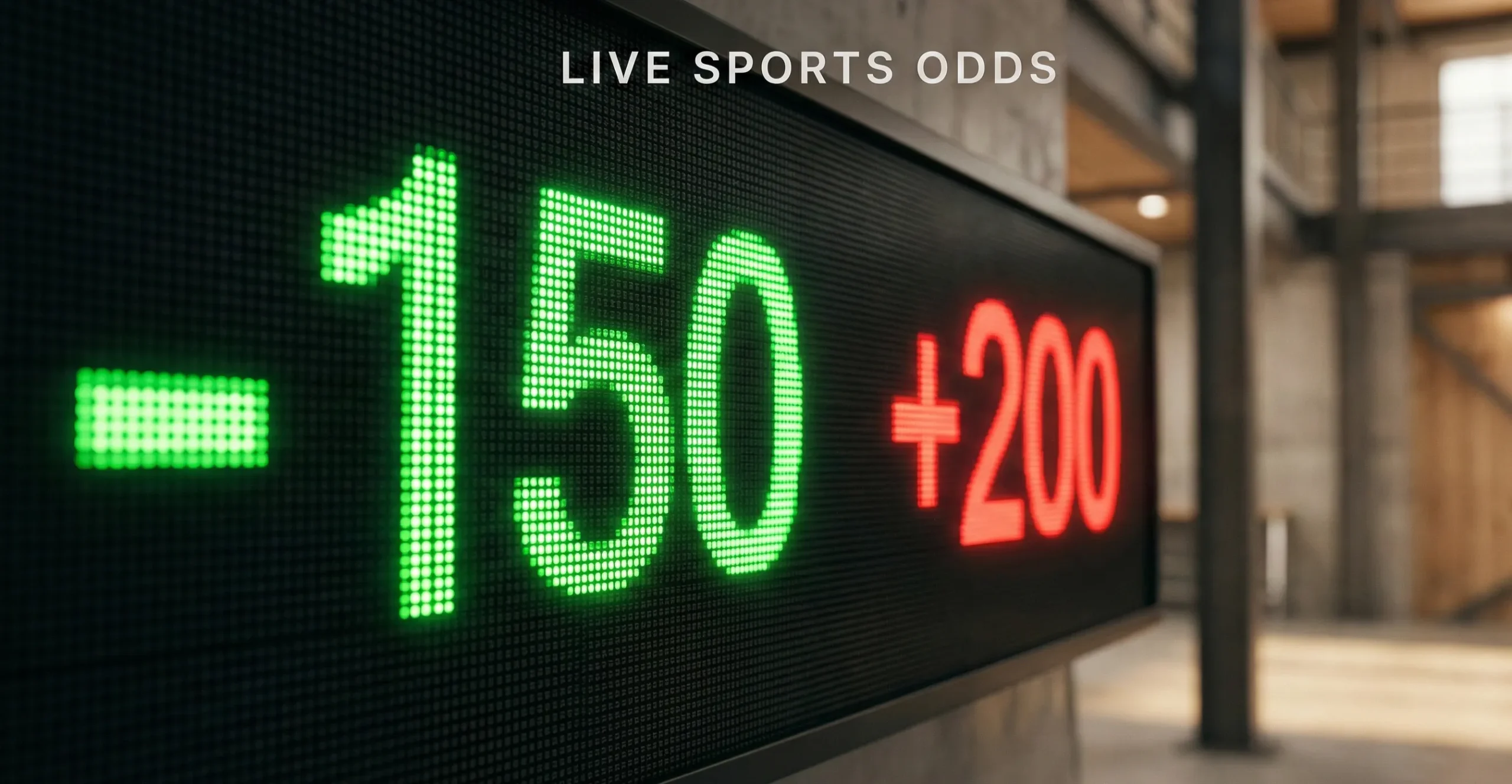
Negative odds indicate the favorite in a matchup. The number tells you how much you need to wager to win $100 in profit. If you see the Kansas City Chiefs listed at -150, you’d need to bet $150 to pocket $100 if they win. Your total return would be $250, which includes your original stake plus the profit. The larger the negative number, the heavier the favorite. A team at -300 is considered much more likely to win than one at -130, and consequently, you’re risking more money for less potential reward. Think of it as the sportsbook saying, “This outcome is pretty likely, so we’re not going to pay you much for predicting it correctly.”
Positive odds represent the underdog. Here, the number tells you how much profit a $100 bet would generate. If the Denver Broncos sit at +200, a successful $100 wager returns $300 total, which is your original $100 plus $200 in profit. Underdogs are considered less likely to win, so the sportsbook rewards you more handsomely for taking that risk. A team at +500 is a significant underdog, paying five times your stake if they pull off the upset.
The standard price you’ll see on most spread bets and totals is -110 on both sides. This means you’re laying $110 to win $100, and that extra $10 represents the sportsbook’s commission, known as the vig or juice. It’s how the house guarantees profit regardless of the outcome. When both sides are -110, the book collects $220 from two opposing bettors and pays out $210 to the winner, keeping $10 for facilitating the transaction.
Decimal Odds: European Simplicity
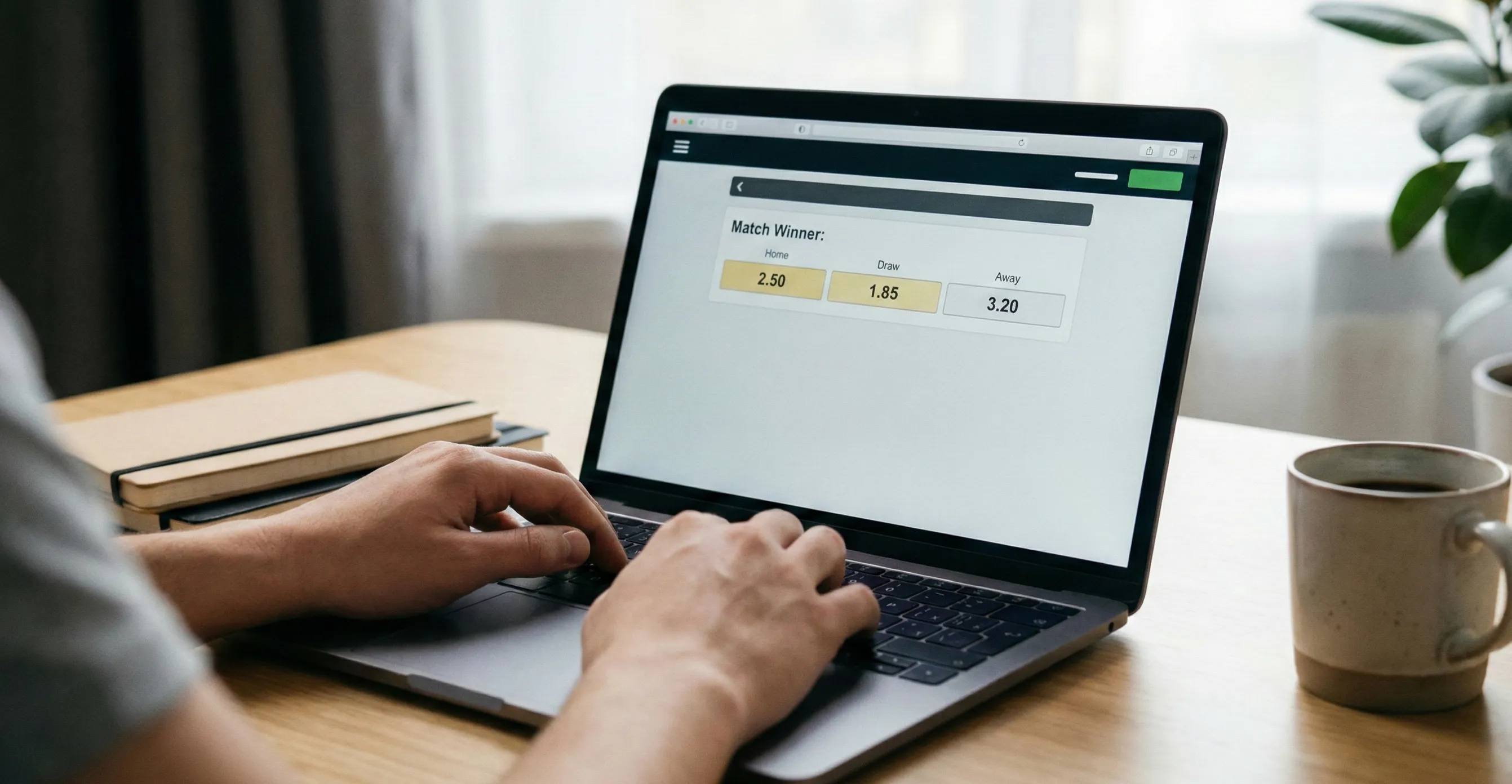
If American odds feel unnecessarily complicated, decimal odds offer a breath of fresh air. Popular throughout Europe, Australia, and Canada, decimal odds represent your total return on a winning bet, including your original stake. The math is beautifully straightforward: multiply your stake by the decimal, and you get your total payout.
A bet at 2.50 odds means every dollar wagered returns $2.50 if successful. Stake $40, and you’re looking at $100 back, which comprises $60 in profit plus your original $40. Decimal odds of 1.50 would return $60 on that same $40 bet, giving you $20 profit. The lower the decimal, the more likely the sportsbook believes the outcome is, similar to how larger negative American odds indicate heavier favorites.
The beauty of decimals lies in their instant clarity. Want to know your profit? Subtract 1 from the decimal and multiply by your stake. At 3.00 odds, your profit multiplier is 2.0, meaning you double your money on a win. At 1.80 odds, your profit multiplier is 0.8, so a $100 bet profits $80. No need to remember different formulas for favorites versus underdogs. The number simply represents your total return per unit wagered.
Decimal odds also make comparing prices across sportsbooks trivially easy. If one book offers 2.45 and another offers 2.50 on the same outcome, you instantly know the second book pays better. Try doing that mental comparison between -150 and -145, and you’ll appreciate why many professional bettors switch their display settings to decimals regardless of what country they’re betting in.
Fractional Odds: The British Tradition
Fractional odds remain the standard in United Kingdom betting shops and dominate horse racing markets worldwide. They express your potential profit relative to your stake as a fraction. If you see odds of 3/1, pronounced “three to one,” you’ll profit $3 for every $1 wagered. A $50 bet at 3/1 returns $200 total, which breaks down to $150 profit plus your $50 stake.
Fractions where the first number exceeds the second, such as 5/2 or 7/4, indicate underdogs. You’re winning more than you’re risking. Conversely, fractions like 1/3 or 2/5 represent favorites where you’re risking more than you stand to win. At 1/3 odds, you need to stake $3 to profit just $1.
The tricky part comes with less intuitive fractions. What does 11/8 actually mean? You’d win $11 for every $8 wagered. A $40 bet returns $95, calculated as $40 multiplied by 11/8, which equals $55 profit, plus your original $40. While fractional odds have historical charm, they’re genuinely harder to work with for quick calculations, which explains why even UK sportsbooks now offer decimal alternatives.
Even money, where you risk the same amount you stand to win, appears as 1/1 in fractional format, often called “evens.” This corresponds to +100 in American odds and 2.00 in decimals. Understanding this baseline helps anchor your conversion between formats.
Converting Between Formats
Knowing how to convert odds isn’t just academic exercise. Different sportsbooks display different formats, and shopping for the best line sometimes means comparing prices across format boundaries. Here are the essential conversions:
American to Decimal:
- For positive American odds: (American odds / 100) + 1 = Decimal
- For negative American odds: (100 / |American odds|) + 1 = Decimal
So +150 becomes (150/100) + 1 = 2.50, and -200 becomes (100/200) + 1 = 1.50.
Decimal to American:
- If decimal is 2.00 or higher: (Decimal – 1) × 100 = Positive American odds
- If decimal is below 2.00: -100 / (Decimal – 1) = Negative American odds
Decimal 3.00 becomes (3.00 – 1) × 100 = +200. Decimal 1.67 becomes -100 / 0.67 = -149.
Fractional to Decimal:
Simply divide the fraction and add 1. So 5/2 becomes 2.5 + 1 = 3.50.
Decimal to Fractional:
Subtract 1 from the decimal and express as a fraction. Decimal 2.50 becomes 1.50, or 3/2.
Most online converters handle these calculations instantly, but understanding the underlying math helps you spot errors and develop intuition for what odds actually mean.
Calculating Implied Probability
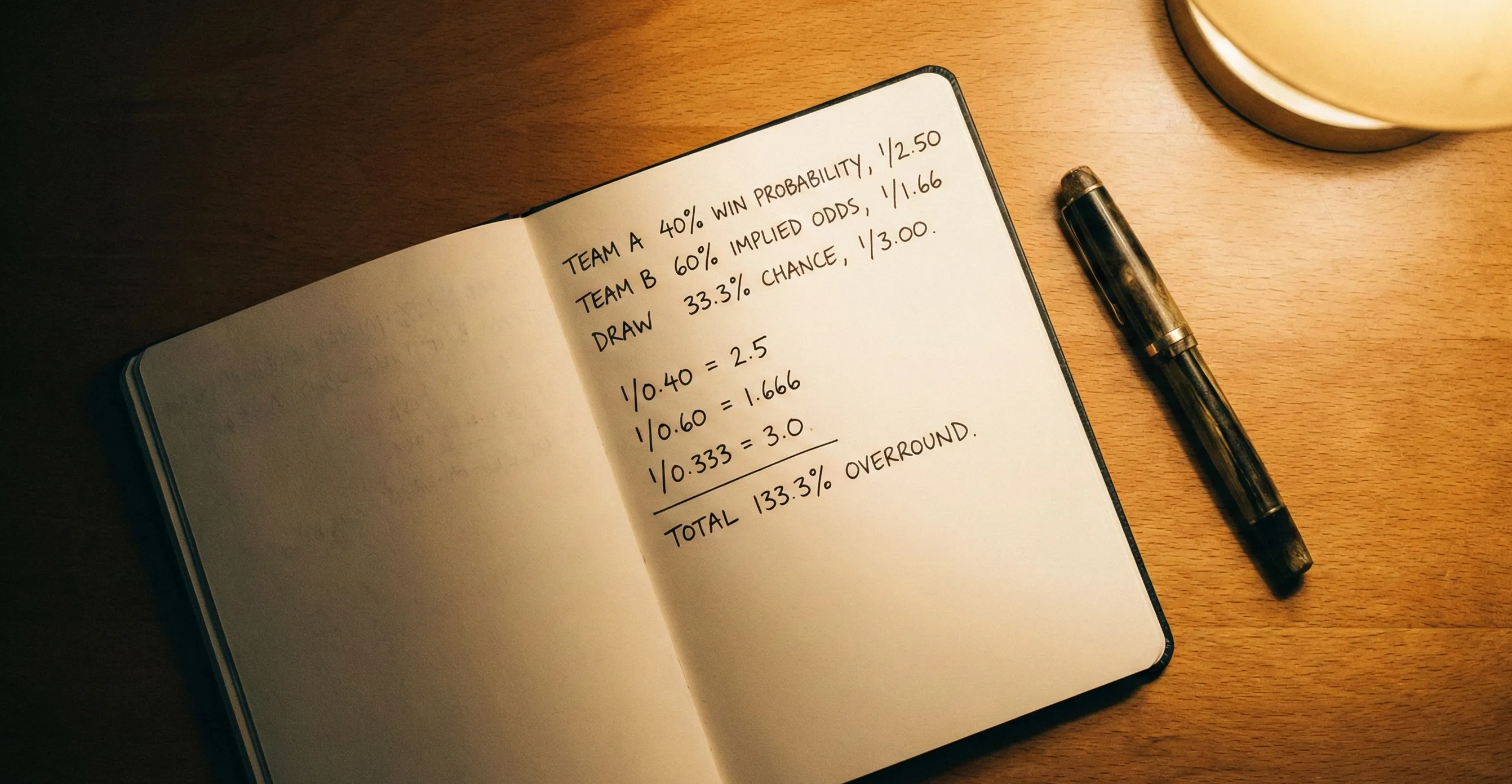
Here’s where reading odds transcends simple payout calculations and becomes a genuine analytical tool. Every set of odds implies a probability of that outcome occurring. Understanding implied probability lets you compare the sportsbook’s assessment against your own analysis to identify potential value.
For positive American odds:
Implied Probability = 100 / (American odds + 100) × 100
At +200, the implied probability is 100 / 300 × 100 = 33.3%.
For negative American odds:
Implied Probability = |American odds| / (|American odds| + 100) × 100
At -150, the implied probability is 150 / 250 × 100 = 60%.
For decimal odds:
Implied Probability = (1 / Decimal odds) × 100
At 2.50 decimal, the implied probability is (1 / 2.50) × 100 = 40%.
Why does this matter? Because if you believe a team has a 50% chance of winning but the sportsbook’s odds imply only a 40% chance, you’ve potentially found value. The odds are paying you as if the outcome is less likely than you believe it to be. Consistently finding and exploiting these discrepancies is the foundation of profitable betting.
Note that when you add up the implied probabilities for both sides of a two-way market, you’ll get more than 100%. That overage represents the vig, the sportsbook’s built-in edge. A typical NFL spread with -110 on both sides has implied probabilities of 52.4% each, totaling 104.8%. The extra 4.8% is essentially the house’s commission baked into the odds.
Practical Application and Line Shopping
Understanding odds formats unlocks one of the most reliable profit-boosting strategies in sports betting: line shopping. Different sportsbooks set slightly different odds on the same events. One book might have the Lakers at -150 while another offers -145. That five-cent difference seems trivial, but it compounds dramatically over hundreds of bets.
Consider two bettors placing identical $100 wagers on favorites throughout a season. If Bettor A consistently takes -150 odds and Bettor B finds -140 on the same outcomes, Bettor B earns roughly 3% more on every winning bet. Over a year of serious betting, that edge translates to thousands of dollars, and it requires zero additional handicapping skill. All it takes is checking multiple books and grabbing the best available price.
The ability to read odds quickly also protects you from making costly mistakes. Sportsbooks occasionally post erroneous lines, and being fluent in odds formats helps you spot when something looks off. More commonly, you’ll simply develop better intuition for when a line offers genuine value versus when you’re paying too high a price for a marginal edge.
Odds literacy transforms you from a recreational bettor hoping for luck into a strategic player making informed decisions. The numbers stop being intimidating and start being informative. Every line tells a story about what the market believes will happen, and your job is to decide whether you agree with that story enough to put money behind it.
See also our odds page.
Master the language of odds, and you’ve taken the first real step toward betting with purpose rather than blind hope.
