

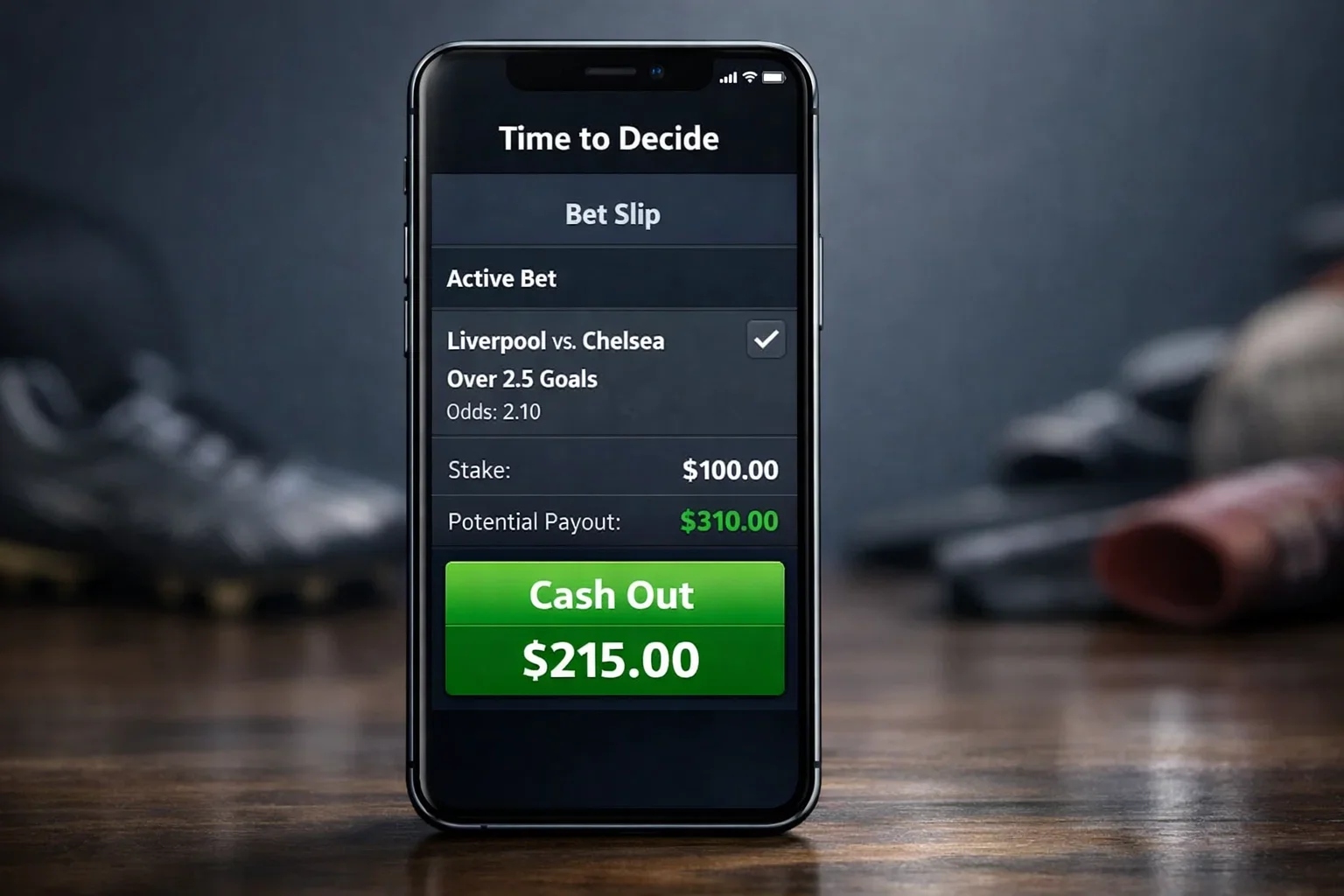
The cash out button beckons from your sportsbook app, offering a tantalizing escape from uncertainty. Your futures bet is alive heading into championship weekend, your parlay has hit four of five legs, or your pregame pick has jumped to an early lead. The sportsbook now offers to buy back your ticket for a guaranteed amount. Click the button and walk away with money in hand; decline and ride the original bet to its natural conclusion.
This feature has become ubiquitous across major sportsbooks, marketed as giving bettors “control” over their wagers. In reality, cash out represents a calculated offer from the sportsbook designed to be profitable for them. Understanding when and why to use it requires examining the mathematics behind these offers and honestly assessing when guaranteed money serves your interests versus when you’re simply surrendering value.
Cash out feature on brom bet.
How Cash Out Offers Work
When you place a bet, you’re buying a position with a defined potential payout. As the game progresses or circumstances change, the current value of that position fluctuates. Cash out offers represent the sportsbook’s assessment of your position’s current value minus their margin.
Consider a futures bet placed at +1000 that now has a true probability of hitting around 25%. The fair value of that position would be 25% of your potential payout plus your stake. But the sportsbook doesn’t offer fair value; they offer less, building in their profit margin on this secondary transaction just as they do on the original bet.
The mechanics involve real-time probability modeling similar to live betting lines. Your cash out offer updates as game conditions change, though usually with some lag and always with the sportsbook’s vig included. When your position improves, cash out offers increase; when it worsens, they decrease. At some point, your position becomes worthless enough that no cash out is offered at all.
For parlays, the calculation incorporates the remaining legs’ probability estimates. If you’ve hit four of five legs, your cash out offer reflects the fifth leg’s implied probability minus the sportsbook’s take. For live bets on games in progress, cash out offers change constantly based on score, time remaining, and game flow.
The Mathematical Reality of Cash Out
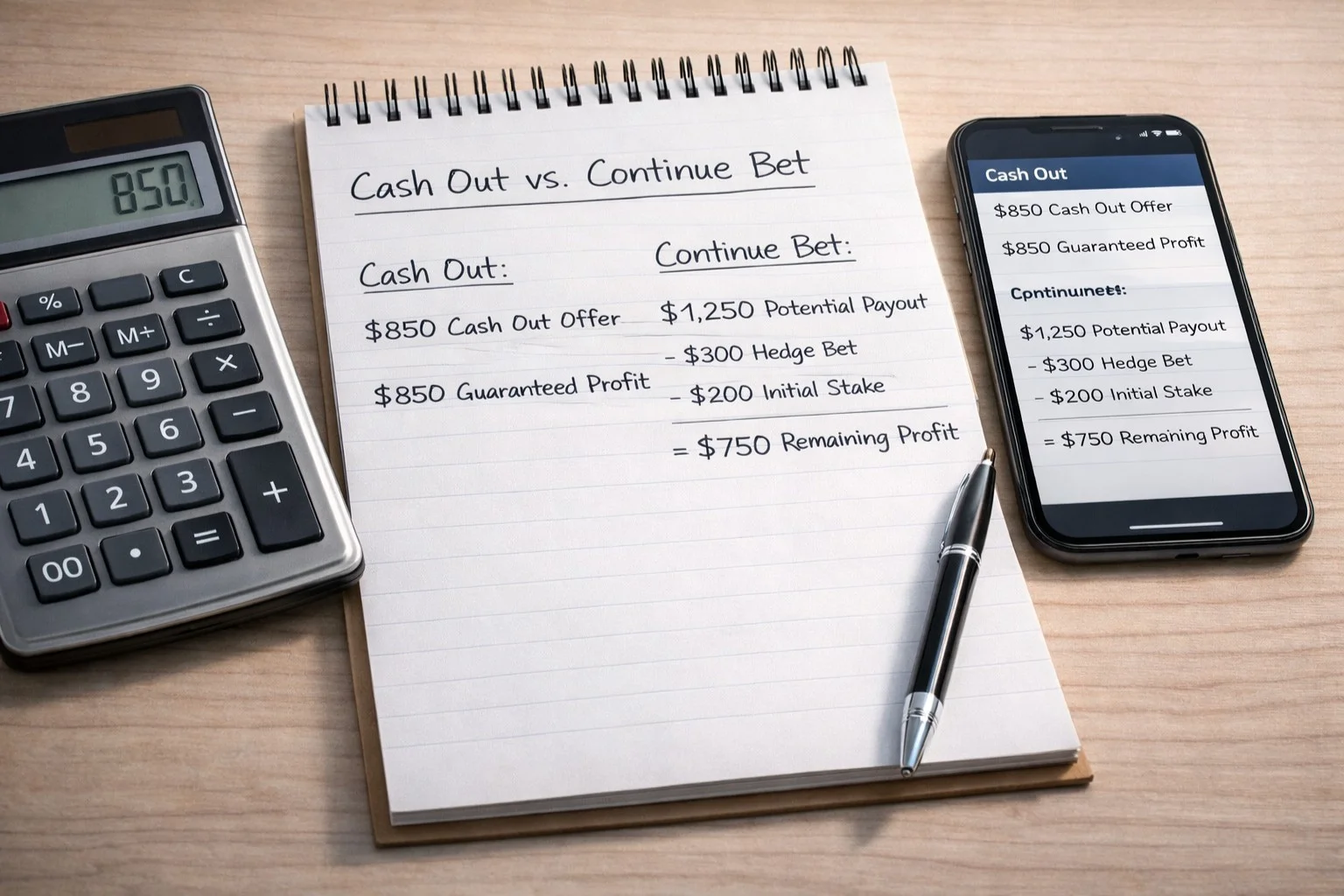
Here’s the uncomfortable truth: cash out offers are almost always negative expected value. The sportsbook isn’t doing you a favor by offering to buy back your bet. They’re offering a price below fair value, profiting on the transaction just as they profit on the original wager.
This is easily demonstrated. If you could consistently find bets with positive expected value, you’d be better off letting them resolve than cashing out early for less than fair value. And if your bets don’t have positive expected value, you shouldn’t have made them in the first place.
The math works against you in both directions. When your position has improved (your team is winning, your futures bet is progressing), the cash out offer is less than the fair value of your improved position. You’re selling low. When your position has worsened (your team is losing, your pick is struggling), the cash out offer is more than the fair value of your diminished position, but you’d often be better off riding out the slight remaining chance of recovery.
Professional bettors almost never use cash out for this reason. They’ve identified value in their original positions and see no reason to surrender that value for a worse-than-fair buyout price. The feature exists primarily for recreational bettors who value emotional relief over mathematical optimization.
When Cashing Out Might Make Sense
Despite the unfavorable mathematics, legitimate reasons exist for using cash out in specific situations. These involve circumstances where the guaranteed money serves real utility beyond its pure expected value.
Life circumstances can change the utility of guaranteed money. If your futures bet represents a life-changing amount and the guaranteed cash out would still be meaningful, the security of locking it in might outweigh the EV sacrifice. This is a personal decision that depends on your financial situation, not a betting strategy question.
Changed analysis that undermines your original thesis can justify cashing out. If you placed a bet based on a quarterback playing and he gets injured during the game, your edge has evaporated even if the cash out offer hasn’t fully reflected this. Selling your now-negative-EV position at the best available price makes sense.
Hedging considerations can make cash out a cleaner alternative. Rather than placing a complex hedge bet with its own vig, a cash out might accomplish the same risk reduction more efficiently. Compare the cash out offer to what you’d net from a manual hedge to determine which approach costs less.
Entertainment value has legitimate weight for recreational bettors. If sweating your last parlay leg would ruin your evening and the cash out amount is satisfactory, the stress relief has value. This isn’t mathematical optimization; it’s acknowledging that betting serves purposes beyond pure profit for many people.
When to Avoid Cashing Out
Most cash out offers should be declined. The situations where cashing out is mathematically sound are rare, and the feature generally extracts value from bettors rather than providing it.
Never cash out based purely on anxiety about losing. The fear of watching a profitable position potentially evaporate doesn’t change the expected value calculation. Emotional discomfort isn’t a valid analytical input; it’s a psychological response the sportsbook is exploiting.
Don’t cash out winners to “lock in profit” when your original thesis remains intact. If you bet a team at +150 because you thought they had 45% win probability, and they’re now winning with 60% probability, cashing out sacrifices the excess value your correct analysis generated. Let your winning analysis pay off fully.
Avoid cashing out losers to “cut losses” unless new information has genuinely changed your probability estimate. A team being down early doesn’t mean your original analysis was wrong; games have variance. Cashing out every time your position dips guarantees you’ll realize the worst price on positions that would have recovered.
The sunk cost fallacy works both ways. Don’t hold onto clearly dead positions out of stubbornness, but don’t abandon live positions prematurely either. The question isn’t how you feel about your past decision; it’s whether the current cash out price exceeds the current fair value of your position.
Partial Cash Out Strategies
Some sportsbooks offer partial cash out, letting you sell some of your position while keeping the rest active. This feature provides more flexibility than all-or-nothing cash out and can serve specific strategic purposes.
Partial cash out resembles partial hedging, locking in some guaranteed return while leaving upside potential. You might cash out half your position to cover your original stake, letting the remaining half ride as pure profit potential. This approach reduces risk without completely abandoning your position.
The same mathematical caveats apply: partial cash outs still offer less than fair value. But for bettors who want risk reduction without full exit, it’s a cleaner mechanism than placing separate hedge bets.
Consider using partial cash out when your position has grown to uncomfortable size relative to your bankroll. A $50 futures bet that’s now worth $400 in cash out might represent too much concentration. Cashing out half reduces your exposure while maintaining a meaningful position.
Analyzing Cash Out Offers

Before accepting any cash out, calculate whether the offer represents fair value for your position’s current state. This requires estimating the true probability of your bet winning from its current position.
For live game bets, compare the cash out offer to what you’d get from placing an opposite live bet. If the cash out offers $200 return and you could bet the other side live to guarantee $220, the manual hedge is superior. Often the discrepancy reveals how much juice the sportsbook has embedded in the cash out offer.
For futures and parlays, estimate the remaining probability and compare to the offer. If your futures bet has 30% chance of hitting and pays $1,000, the fair value is around $300. A cash out offer of $250 represents a 17% haircut, which is substantial. Whether that haircut is acceptable depends on your circumstances.
Track your cash out decisions over time. If you cash out frequently and later calculate what you would have made by holding, you’ll develop a sense for whether your instincts are costing you money. Most bettors who track this discover they’d be better off never using the feature.
The Sportsbook’s Perspective
Understanding why sportsbooks aggressively promote cash out helps contextualize why it’s usually not in your interest. The feature is profitable for sportsbooks because they buy positions below fair value from bettors willing to accept certainty over optimal returns.
Sportsbooks also benefit from cash out’s ability to reduce their variance. When a bettor cashes out a potentially expensive winning position, the sportsbook eliminates their liability on that bet for less than they’d have to pay if it hit. This risk reduction has value to the book beyond the direct profit margin on the cash out offer itself.
The psychological design of cash out exploits loss aversion and certainty bias. People feel losses more acutely than equivalent gains and prefer certain outcomes over uncertain ones even when the uncertain option has higher expected value. Cash out buttons appear at moments of maximum emotional vulnerability, when you’re watching your bet potentially slip away.
See also our live betting page.
None of this means cash out is always wrong to use, but it does mean the feature is designed to benefit sportsbooks first and bettors second. Approach cash out offers with the skepticism appropriate for any sportsbook product and use them only when genuine strategic or personal reasons justify accepting less than fair value for your positions.
