

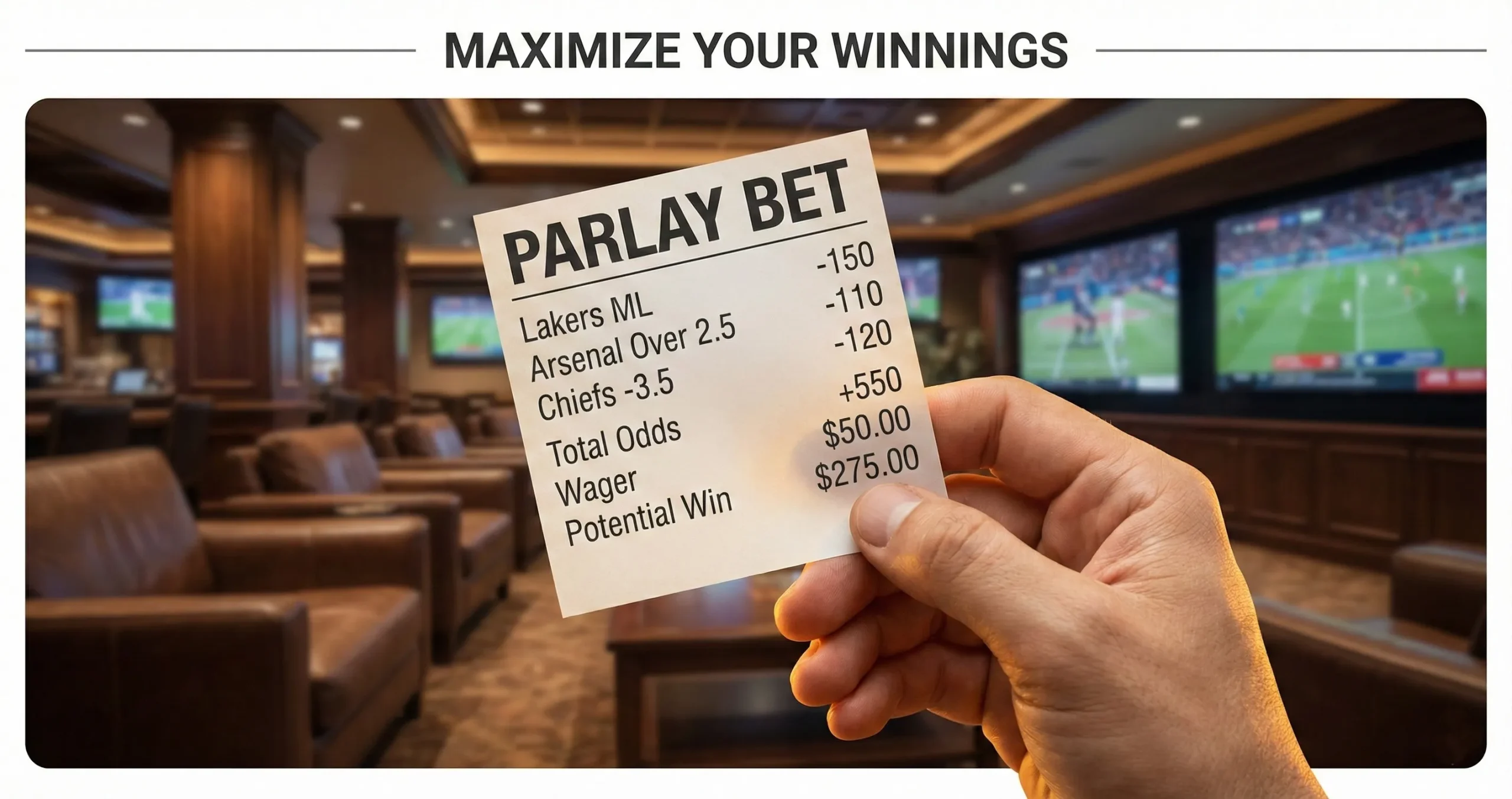
The allure of the parlay is undeniable. Take a few confident picks, combine them into a single ticket, and watch as modest stakes transform into substantial payouts. It’s the lottery ticket of sports betting, the reason sportsbooks prominently feature parlay options in their apps and the subject of countless social media screenshots showing four-figure wins from five-dollar bets. Yet beneath this glamour lies a mathematical reality that explains why sportsbooks love parlays even more than bettors do.
A parlay combines two or more individual bets into one wager where every selection must win for the ticket to cash. Miss on a single leg, and the entire parlay loses regardless of how the other picks performed. This all-or-nothing structure creates the dramatic payout potential that attracts bettors, but it also compounds the house edge in ways that significantly favor the sportsbook. Understanding exactly how parlays work, how their odds are calculated, and when they might actually make strategic sense separates informed bettors from those simply chasing dreams.
Parlay betting on brom bet.
How Parlay Mechanics Work
When you place a parlay, you’re essentially rolling your winnings from each successful leg into the next bet on your ticket. If you parlay three teams at -110 odds each, winning the first leg means your stake plus winnings move to the second leg, and winning that moves everything to the third. Only after all three hit do you collect anything at all.
This mechanism explains both the appeal and the danger of parlays. Each leg multiplies the potential payout, but each leg also multiplies the risk. A two-team parlay at standard -110 odds pays roughly +264, meaning a $100 bet returns about $364 total. Add a third leg, and that payout jumps to around +595. Four legs push past +1200. The numbers grow intoxicating as more selections enter the picture.
Yet the flip side is equally dramatic. A two-team parlay with 50% individual win rates has only a 25% chance of hitting. Three teams drops to 12.5%. Four teams falls to 6.25%. By the time you reach a ten-team parlay, your hit rate sits below 0.1%, or roughly one win per thousand attempts. The massive payouts exist precisely because the probability of success becomes vanishingly small.
Calculating Parlay Odds and Payouts
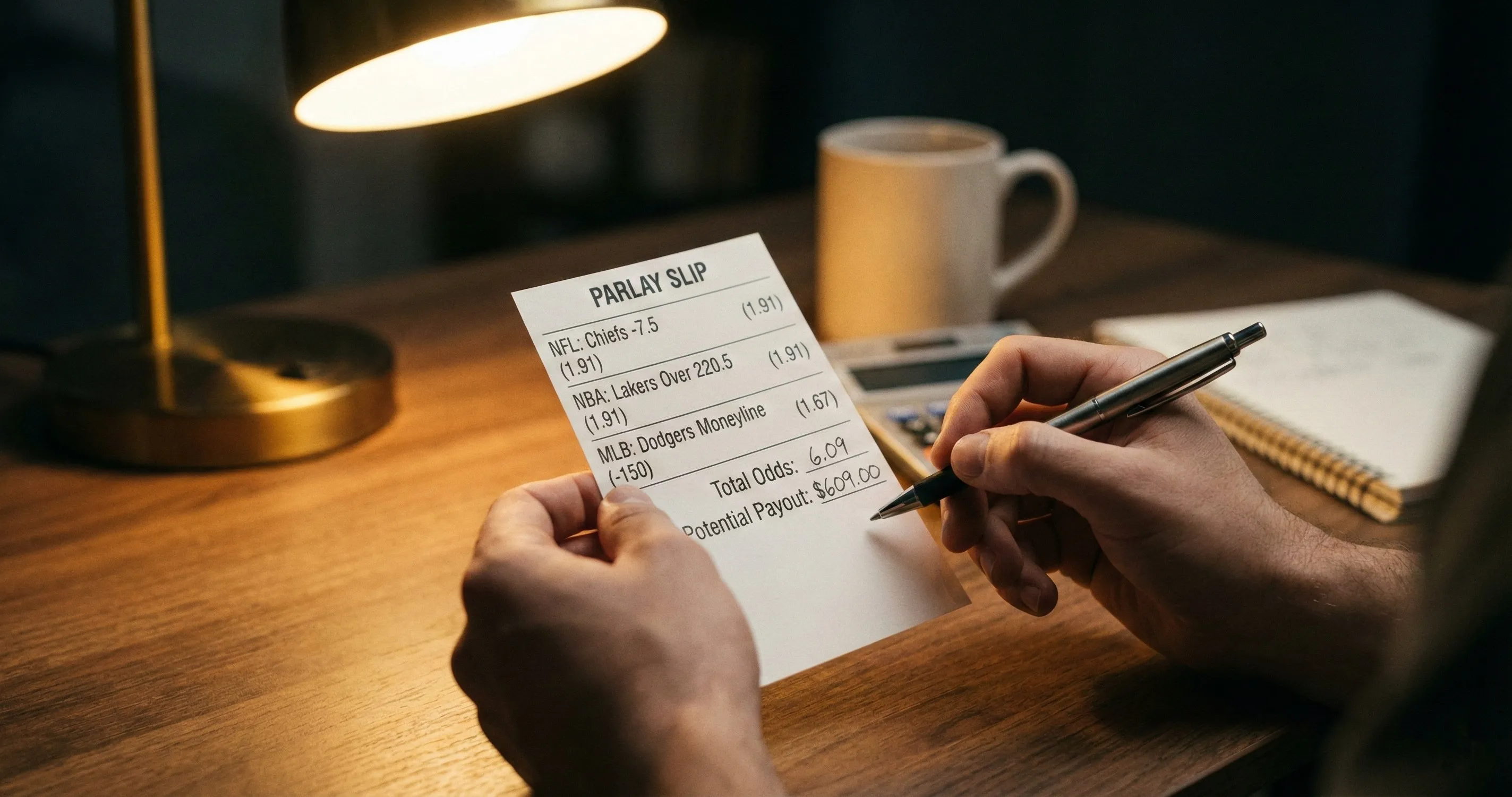
The math behind parlay odds is straightforward once you understand the process. First, convert each leg’s American odds to decimal format. For negative odds like -110, divide 100 by the absolute value and add 1. So -110 becomes 100/110 + 1 = 1.909. For positive odds like +150, divide by 100 and add 1, giving 1.50 + 1 = 2.50.
Next, multiply all the decimal odds together. A three-team parlay with each leg at 1.909 produces 1.909 × 1.909 × 1.909 = 6.95. This decimal represents your total return per dollar wagered, so a $100 bet would return $695, which is $595 in profit plus your original $100 stake. Converting back to American odds, subtract 1 from the decimal and multiply by 100, giving +595.
Many sportsbooks, particularly retail locations in Las Vegas, use fixed-odds parlay cards that assume standard -110 juice on each leg. These cards offer predetermined payouts based on the number of legs rather than calculating true odds from each selection. The fixed-odds approach typically pays slightly less than true odds would, adding another layer of house advantage beyond the already-compounded vig.
When your parlay includes legs at different odds, the calculation still works the same way, but the results vary more dramatically. Mixing heavy favorites with underdogs produces different payouts than combining all -110 selections. A parlay including a -300 favorite (decimal 1.333) alongside two +150 underdogs (decimal 2.50 each) would calculate as 1.333 × 2.50 × 2.50 = 8.33, or +733 in American odds.
The House Edge on Parlays
Here’s where parlays reveal their true cost. While a single bet at -110 carries a house edge of about 4.55%, parlays don’t simply maintain that edge. They compound it. Each leg adds its own vig to the equation, and the combined effect exceeds what bettors typically realize.
Consider a two-team parlay where each leg represents a true 50/50 proposition priced at -110. The fair parlay odds for two coin flips would be +300, reflecting the 25% probability of winning both. But the -110 juice on each leg reduces the actual payout to about +264. That gap between +300 and +264 represents the extra house edge parlays extract.
The effect intensifies with more legs. A four-team parlay of true 50/50 propositions should pay +1500 to be fair, but the compounded juice reduces actual payouts to around +1228 at standard -110 per leg. By ten legs, you’re looking at payouts of roughly +750 instead of the mathematically fair +1023. Sportsbooks absolutely love when customers load up on long-shot parlays, because the compounding vig ensures substantial profit margins regardless of short-term results.
This mathematical reality leads most professional bettors to avoid parlays entirely. The compounding juice means you need increasingly larger edges on each individual leg to justify combining them. If you have a genuine 54% edge on each of three individual bets, parlaying them sacrifices expected value compared to betting them straight. The logic is simple: why volunteer to pay extra vig when you don’t have to?
When Parlays Actually Make Sense
Despite the unfavorable mathematics, certain situations exist where parlays can be strategically justified. The most compelling involves correlated outcomes, where the results of two events are linked in ways the sportsbook hasn’t fully priced.
Traditional parlays don’t allow correlated bets from the same game, but some edges can exist across different games. If two teams share a particularly favorable situational angle, or if market inefficiencies affect multiple games in similar ways, parlaying those picks could capture value. The key is that your edge on the combined outcome exceeds the extra vig the parlay format extracts.
Bankroll management presents another scenario where parlays serve a purpose. If you have strong conviction on several outcomes but limited betting capital, a parlay allows you to gain exposure to all of them without spreading your bankroll too thin. You’re accepting lower expected value in exchange for the chance at a transformative payout. This approach makes sense only when the entertainment value or life-changing potential justifies the mathematical sacrifice.
Some betting strategies specifically exploit parlay structures. Certain teaser combinations, particularly those crossing key numbers in football, have historically shown positive expected value despite the parlay format. Sharp bettors who specialize in this area know exactly which combinations offer value and which to avoid. For them, the parlay is simply a vehicle for a specific bet type rather than a general strategy.
What Happens With Pushes and Cancellations
Parlay rules around pushes and cancellations vary by sportsbook, so understanding the specific terms before betting matters. Most books handle pushes by removing that leg from the parlay entirely, recalculating the payout as if it never existed. A four-team parlay with one push becomes a three-team parlay at reduced odds.
Using the earlier math: if you placed a four-team parlay at 1.909 decimal odds per leg and one game pushes, your payout drops from 1.909^4 = 13.28 to 1.909^3 = 6.95. The push doesn’t kill your ticket, but it significantly reduces the potential return. Some bettors specifically buy half-points to avoid potential push scenarios, though whether that juice is worth paying depends on the specific numbers involved.
Cancelled games, postponements, and player scratches typically work the same way as pushes, with the affected leg removed and the parlay recalculated. However, some sportsbooks have different rules for these scenarios, particularly around player props where the target player doesn’t participate. Always check the house rules before placing action, especially on parlays involving props or less common markets.
Building Smarter Parlays

If you’re going to bet parlays despite their mathematical disadvantages, certain principles can minimize the damage. First, keep your parlay legs to two or three selections maximum. The vig compounds exponentially with each added leg, so shorter parlays sacrifice less value than long-shot tickets with eight or ten legs.
Second, shop for the best line on each individual leg before building your parlay. The difference between -110 and -105 on three separate legs translates to meaningful payout differences when multiplied together. Some sportsbooks offer better parlay odds than others, and some run promotions that reduce parlay juice or offer insurance on near-misses.
Third, be honest about your edge. If you’re betting parlays recreationally with no real analytical advantage, acknowledge that you’re paying for entertainment and size your bets accordingly. If you genuinely believe you have edges on multiple games, consider whether those edges actually exceed the extra vig you’re paying to combine them.
Fourth, avoid the trap of parlay chasing. Losing streaks can tempt bettors to load up on bigger parlays hoping for one big hit to recover losses. This approach typically accelerates the downward spiral rather than reversing it. Parlays are highest-variance bets, and variance during bad runs cuts both ways.
See also same game parlay.
The bottom line on parlays is that they work exactly as designed: generating excitement and substantial profits for sportsbooks while occasionally delivering life-changing scores to lucky bettors. Understanding the mathematics doesn’t eliminate the fun, but it should inform your expectations and betting patterns. Used sparingly and strategically, parlays can have a place in your betting approach. Used carelessly, they’re the fastest way to donate money to the sports betting industry.
