


Sportsbook bonuses represent free money, or so the advertisements claim. The reality is more nuanced. Bonuses do provide genuine value, but extracting that value requires understanding how they actually work. The bettor who blindly claims every bonus without reading terms often ends up worse off than the bettor who approaches promotions strategically.
The sportsbook industry spends billions on customer acquisition, and bonuses form the centerpiece of that spending. This investment only makes sense if bonuses ultimately benefit the house more than the players. Understanding this dynamic helps you identify which bonuses provide real value and which serve primarily to generate betting volume that favors the sportsbook.
Sports betting bonuses on brom bet.
Types of Welcome Bonuses
Deposit match bonuses add bonus funds equal to a percentage of your initial deposit. A “100% match up to $500” means depositing $500 gives you $500 in bonus funds on top of your deposited cash. These bonus funds typically cannot be withdrawn directly but convert to withdrawable cash after meeting playthrough requirements.
Risk-free first bets refund your initial wager if it loses. If you place a $1,000 risk-free bet and lose, you receive $1,000 back, usually as site credit or bonus bets rather than cash. If you win, you keep your winnings normally. These offers reduce the downside of your first bet without eliminating it entirely.
Bonus bets, sometimes called free bets, let you place wagers without risking your own money. If the bonus bet wins, you receive the winnings but not the original stake amount. A $100 bonus bet at +100 odds that wins pays $100, not $200. This distinction significantly affects their actual value.
Second chance bets offer refunds on specific bet types if certain conditions are met. “Get your money back if your team loses by exactly one point” or similar promotions provide insurance against narrow losses. These bonuses have value but apply to limited situations.
No deposit bonuses provide small amounts of bonus funds just for creating an account, without requiring any deposit. These offers are rare and typically small but represent pure upside with no risk.
Understanding Playthrough Requirements
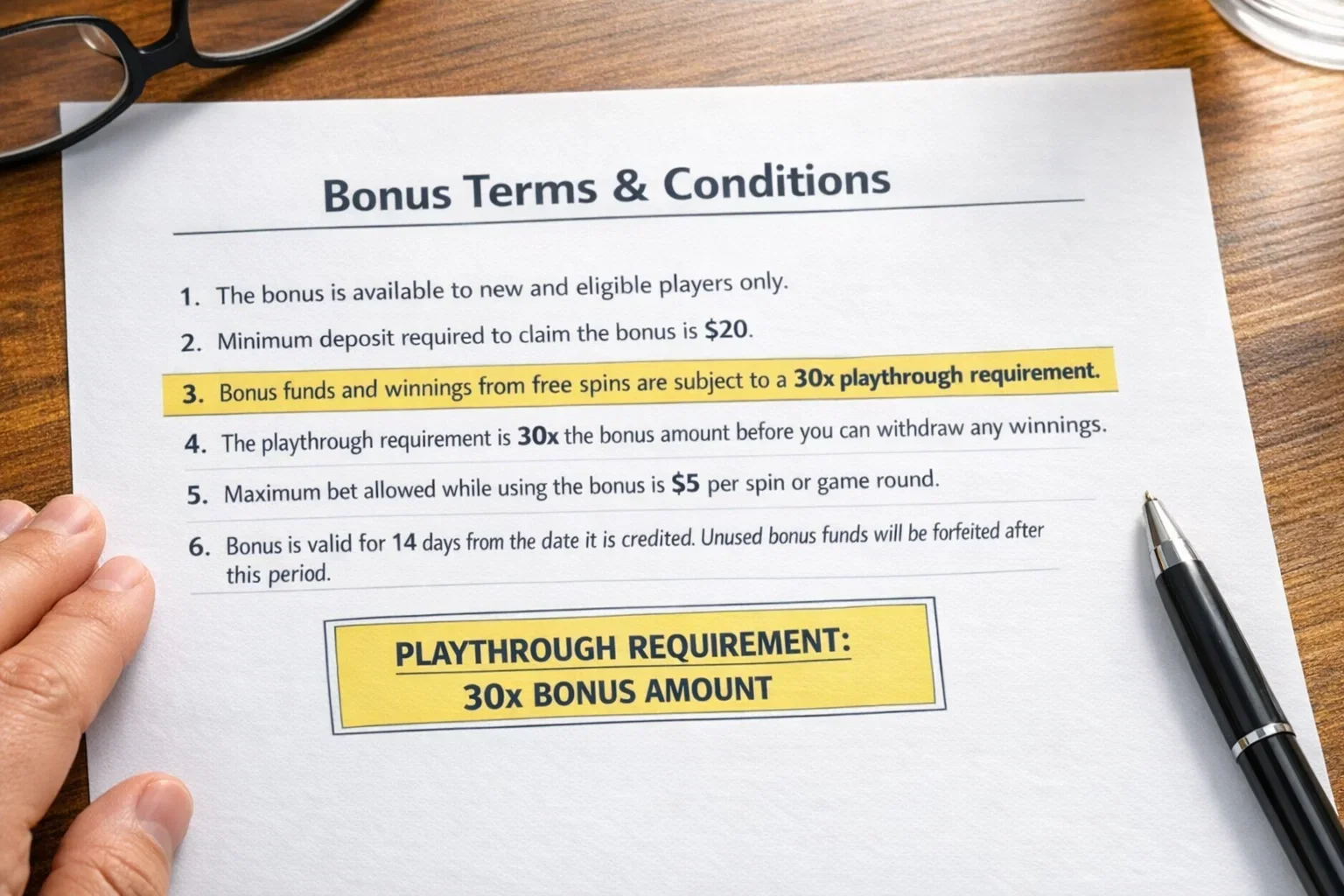
Playthrough requirements, also called rollover or wagering requirements, specify how many times you must bet bonus funds before withdrawing. This single factor determines whether a bonus has genuine value or merely creates betting volume that benefits the sportsbook.
A $500 bonus with 1x playthrough requires betting $500 total before withdrawal. At standard -110 juice, you’d expect to lose about $22.50 on that volume, making the bonus worth roughly $477.50 in expected value. That’s excellent value.
The same $500 bonus with 10x playthrough requires betting $5,000. Expected losses on that volume at -110 juice approach $225, reducing the bonus’s expected value to around $275. Still positive, but dramatically less attractive than the headline number suggests.
Some bonuses carry 20x or higher playthrough requirements. At these levels, expected losses during playthrough can exceed the bonus amount, making the promotion negative expected value despite appearing generous. Always calculate expected playthrough cost before claiming any bonus.
Playthrough typically applies only to bonus funds, not your deposited cash. However, some books combine bonus and deposit amounts for playthrough calculations, effectively trapping your deposit until requirements are met. Read terms carefully to understand exactly what’s subject to playthrough.
Bonus Terms That Reduce Value
Beyond playthrough requirements, various terms and conditions limit bonus value in ways casual readers might miss.
Eligible bet restrictions exclude certain wagers from counting toward playthrough. Many bonuses don’t count bets below -200 odds or above +200 odds, forcing you to bet at odds where the house edge is most pronounced. Parlay requirements that mandate multiple legs increase variance and expected loss.
Time limits force you to complete playthrough within specified periods, often 30 days or less. Rushed betting to meet deadlines leads to poor decisions and increased losses. If you can’t comfortably complete playthrough in the allowed time, the bonus might not suit your betting volume.
Maximum bet limits during playthrough prevent you from clearing requirements efficiently with a few large bets. Being forced to place many small bets increases the number of times you pay juice, reducing expected value.
Withdrawal restrictions might require forfeiting remaining bonus funds if you withdraw before completing playthrough. Understanding when you can access your money without penalty helps plan your bonus strategy.
Game and sport restrictions limit which markets count toward playthrough. A bonus that only counts football bets has no value if you primarily bet basketball. Match bonus availability to your actual betting interests.
Calculating True Bonus Value
Estimating a bonus’s actual expected value requires accounting for all terms and conditions, not just the headline offer amount.
Start with the bonus amount. A $500 bonus is your maximum possible gain before accounting for costs.
Calculate expected playthrough losses. Multiply total playthrough volume by expected house edge on eligible bets. For standard spreads at -110, expect to lose about 4.5% of volume. A $500 bonus with 10x playthrough on $5,000 volume costs approximately $225 in expected losses.
Subtract expected losses from the bonus amount. In this example, $500 minus $225 equals $275 in true expected value.
Factor in any additional costs or restrictions. If terms force you to bet unfavorable markets or compress your timeline, actual value decreases further.
Compare true expected value across offers. A $250 bonus with 1x playthrough might be worth more than a $500 bonus with 10x playthrough, despite the smaller headline number.
Bonus Bet Strategy
Bonus bets differ from regular bets in one crucial way: you don’t receive the stake back when you win. This changes optimal strategy for using them.
The expected value of a bonus bet equals the win probability times the potential winnings. A $100 bonus bet at +100 odds (50% implied probability) has expected value of roughly $50 at fair odds. At actual odds including juice, it’s slightly less.
Longer odds increase bonus bet value proportionally. A $100 bonus bet at +300 odds returns $300 if it wins. Even at lower win probability, the expected value can exceed shorter-odds alternatives because you’re not losing a stake on losses.
This dynamic suggests using bonus bets on longer odds than you’d normally bet, though not at extreme longshots where win probability approaches zero. Sweet spots typically fall in the +150 to +400 range, where win probability remains meaningful while payout multiples enhance value.
Don’t use bonus bets on heavy favorites. A $100 bonus bet at -300 returns only $33.33 if it wins. Even with high win probability, the expected value is poor because you’re giving up significant potential by not receiving the stake back.
Maximizing Sign-Up Bonus Value

Strategic approaches to welcome bonuses extract more value than casual claiming.
Open accounts at multiple sportsbooks to claim multiple welcome bonuses. Each legitimate sportsbook offers its own sign-up promotion, and claiming several multiplies your bonus opportunity. Having accounts at multiple books also enables line shopping that provides ongoing value beyond bonuses.
Time your account openings strategically. Some books offer enhanced promotions during major events like the Super Bowl or March Madness. Waiting for promotional periods can increase bonus value significantly.
Match deposit amounts to bonus maximums. If a book offers 100% match up to $500, depositing less than $500 leaves bonus money on the table. Deposit the full amount eligible for matching when bonuses have reasonable terms.
Complete playthrough efficiently by betting your normal volume on standard markets. Don’t force extra bets just to clear bonuses faster; the increased activity at poor prices costs more than the time saved.
Ongoing Promotions for Existing Customers
Welcome bonuses grab attention, but ongoing promotions often provide more cumulative value for active bettors.
Daily odds boosts enhance payouts on specific bets. A boost from +100 to +125 on a bet you’d make anyway adds pure value. Evaluate whether boosted bets align with your regular betting rather than chasing boosts on markets you wouldn’t otherwise consider.
Profit boost tokens multiply winnings by specified percentages. A 50% profit boost on a winning bet adds significant value, particularly on larger wagers. Save these tokens for bets where you have genuine edge.
Parlay insurance refunds losing parlays that miss by one leg. This promotion reduces parlay risk, making multi-leg bets slightly more attractive than they otherwise would be.
Loyalty programs and VIP tiers reward continued betting with benefits that increase over time. High-volume bettors should factor loyalty rewards into sportsbook selection, as these programs provide ongoing value that can exceed welcome bonus amounts.
Responsible Bonus Hunting
Bonuses should enhance a betting approach you’d pursue anyway, not drive you to bet more than you otherwise would. The house edge applies to bonus-driven bets just as it does to regular bets.
Never bet beyond your bankroll management limits to chase bonus clearance. The expected value of a bonus doesn’t justify the variance of oversized bets. If completing playthrough requires bets larger than your normal sizing, either extend your timeline or accept that you won’t fully utilize the bonus.
Avoid low-value bonuses that primarily generate betting volume. Some promotions aren’t worth the effort required to claim them. Be selective about which bonuses you pursue rather than reflexively claiming everything offered.
See also how to choose a sportsbook.
Remember that sportsbooks profit from bonuses on average. The promotions exist because they generate positive expected value for the house across all customers. You can be among the customers who extract value, but only through strategic, disciplined bonus utilization.
