
Every profession has its jargon, and sports betting is no exception. Walk into a conversation between experienced bettors and you’ll hear words like “chalk,” “steam,” and “vig” thrown around casually. Understanding this vocabulary isn’t just about fitting in. It’s about comprehending what you’re actually doing when you place a bet and interpreting the information that sportsbooks and handicappers provide.
This glossary covers the essential terminology you’ll encounter in your betting journey, from basic concepts every beginner needs to advanced terms used by professional handicappers. Keep this as a reference because you’ll definitely encounter these words and phrases across sportsbooks, betting forums, and analysis content.
Sports betting glossary on brom bet.
Fundamental Betting Terms
Action refers to any wager placed on a sporting event. When someone says they have “action” on a game, they’ve bet on it. The term can also describe whether a bet is valid, as in “no action” when a starting pitcher is scratched in baseball.
Bankroll is the total amount of money you’ve set aside specifically for betting. Professional bettors treat their bankroll as operating capital and never bet money they can’t afford to lose. Your bankroll size determines your unit size and overall betting strategy.
Book or Sportsbook is any entity that accepts bets on sporting events. The term originated from the physical books where bookmakers recorded wagers. Today’s books are sophisticated operations with trading floors, risk managers, and algorithms that set and adjust lines.
Cover means winning against the point spread. If the Cowboys are -7 and win 31-20, they covered by four points. Underdogs cover by winning outright or losing by fewer points than the spread.
Chalk refers to the favorite in any matchup. Heavy chalk means a significant favorite. The term supposedly originated from the days when odds were written on chalkboards, with favorites getting the most attention and chalk residue.
Dog or Underdog is the team or player expected to lose. Underdogs receive points in spread betting and positive odds on moneylines. Smart bettors know that underdogs win frequently enough to offer long-term value at the right prices.
Edge represents any advantage a bettor believes they have over the sportsbook. Edges come from superior information, analytical models, or finding pricing inefficiencies. Betting without an edge means relying on luck.
Handle is the total amount of money wagered on a particular event or during a time period. A Super Bowl might generate a handle exceeding $150 million at a single sportsbook. High handle doesn’t necessarily mean high profits since the result determines whether the book wins or loses.
Limit is the maximum bet a sportsbook will accept on a particular market. Recreational bettors rarely encounter limits, but sharps routinely get limited as books identify them as winning players.
Line refers to the odds or point spread on any given bet. Lines include moneylines, point spreads, and totals. Lines move based on betting action, injuries, weather, and other factors.
Odds and Pricing Terms
Juice or Vig (short for vigorish) is the commission sportsbooks charge on bets. Standard juice is -110, meaning you risk $110 to win $100. Reduced juice books offer -105 or better, significantly improving long-term profitability.
Even Money is any bet that pays 1:1, listed as +100 or -100 in American odds. True even money bets are rare since books need their margin.
Plus Money describes any positive odds where your potential profit exceeds your stake. Sharp bettors often seek plus money situations because winning less than 50% of bets can still be profitable.
Laying Points means betting on the favorite. When you “lay 7” on the Chiefs, you’re betting them -7. Laying is contrasted with “taking,” which refers to betting underdogs.
Taking Points means betting on the underdog and receiving the point spread advantage. Taking points gives you a cushion where your team can lose and you still win.
Opening Line is the first line released by sportsbooks on an event. These initial numbers represent the market’s starting point before significant betting action shapes the final price.
Closing Line is the final line available before an event begins. The closing line is considered the most accurate reflection of true probability. Professional bettors measure their skill by whether they consistently beat the closing line.
Steam describes rapid, significant line movement across multiple sportsbooks simultaneously. Steam moves typically occur when sharp syndicates bet heavily or when significant injury news breaks. By the time you notice steam, the value has usually evaporated.
Bet Types and Structures
Straight Bet is any single wager on one outcome. Betting the Cowboys -7 is a straight bet. Betting the over 48.5 is a straight bet. Straight bets are the foundation of all sports wagering and offer the best odds of winning compared to combined bets like parlays.
Parlay combines multiple bets into a single wager where all selections must win for the bet to pay. A three-team parlay at standard -110 prices pays roughly +600. Parlays offer higher payouts but exponentially lower win rates. Most sharp bettors avoid parlays because the compounding juice destroys long-term value.
Teaser allows bettors to adjust point spreads in their favor across multiple games in exchange for reduced odds. A standard NFL teaser moves each spread six points. These adjustments can turn -7 favorites into -1 favorites or +3 underdogs into +9 underdogs. Unlike parlays, certain teaser configurations have historically shown positive expected value.
Prop Bet or Proposition Bet covers any wager not directly tied to the game’s final score or outcome. Player props include individual statistics like passing yards or rebounds. Game props include first team to score, whether the game goes to overtime, or margin of victory. Props have exploded in popularity with the rise of daily fantasy sports crossover.
Futures are bets on events that will be determined in the future, typically weeks or months away. Betting the Bills to win the Super Bowl in October is a futures bet. Season win totals and MVP odds are futures markets. These bets tie up capital for extended periods but offer potential value when you identify mispriced long-term outcomes.
Live Betting or In-Play Betting involves wagering on games already in progress. Lines adjust continuously based on score, time remaining, and game flow. Live betting requires quick decision-making and carries higher juice than pre-game markets. Sharp bettors find opportunities when live lines overreact to game events.
Push occurs when a bet results in a tie against the spread or total. If the Cowboys are -7 and win 27-20, the bet pushes. Pushes return your original stake without profit or loss. Half-point lines, called hooks, eliminate push possibilities.
Bettor Types and Market Dynamics
Sharp describes professional or highly sophisticated bettors whose opinions move lines. When sharps bet, sportsbooks adjust. Sharp action often contradicts public betting percentages. The term also describes betting sides that align with sharp opinion, as in “the sharp side is the under.”
Square refers to recreational or casual bettors who bet for entertainment rather than profit. Squares tend to bet favorites, home teams, overs, and popular franchises. Sportsbooks love squares because they generally lose over time. Being called a square isn’t necessarily insulting since most bettors bet recreationally.
Wiseguy is another term for sharp or professional bettor. Wiseguys have long-term winning records and bet enough volume to concern sportsbooks. The term has historical connections to organized betting operations but now generally means any respected winning bettor.
Public or Public Money refers to betting action from recreational bettors. When 75% of tickets are on one side, that’s heavy public action. Public money tends to overvalue favorites, high-profile teams, and recent performance. Sportsbooks track public percentages and often shade lines toward public tendencies.
Reverse Line Movement occurs when a line moves opposite to betting percentages. If 80% of bets are on the Packers -3 but the line moves to Packers -2.5, sharp money on the other side is moving the number despite public opinion. Reverse line movement is one indicator of sharp action.
Middling is a strategy where bettors attempt to win both sides of a bet by taking advantage of line movement. If you bet Cowboys -3 early and the line moves to Cowboys -6, you could bet the opponent +6 and potentially win both if the Cowboys win by 4 or 5. Successful middles are rare but profitable when they hit.
Fading means betting against someone or something. Fading the public means betting opposite public consensus. Fading a handicapper means betting against their picks. The term implies contrarian positioning based on the belief that the faded entity is wrong.
Results and Record Keeping
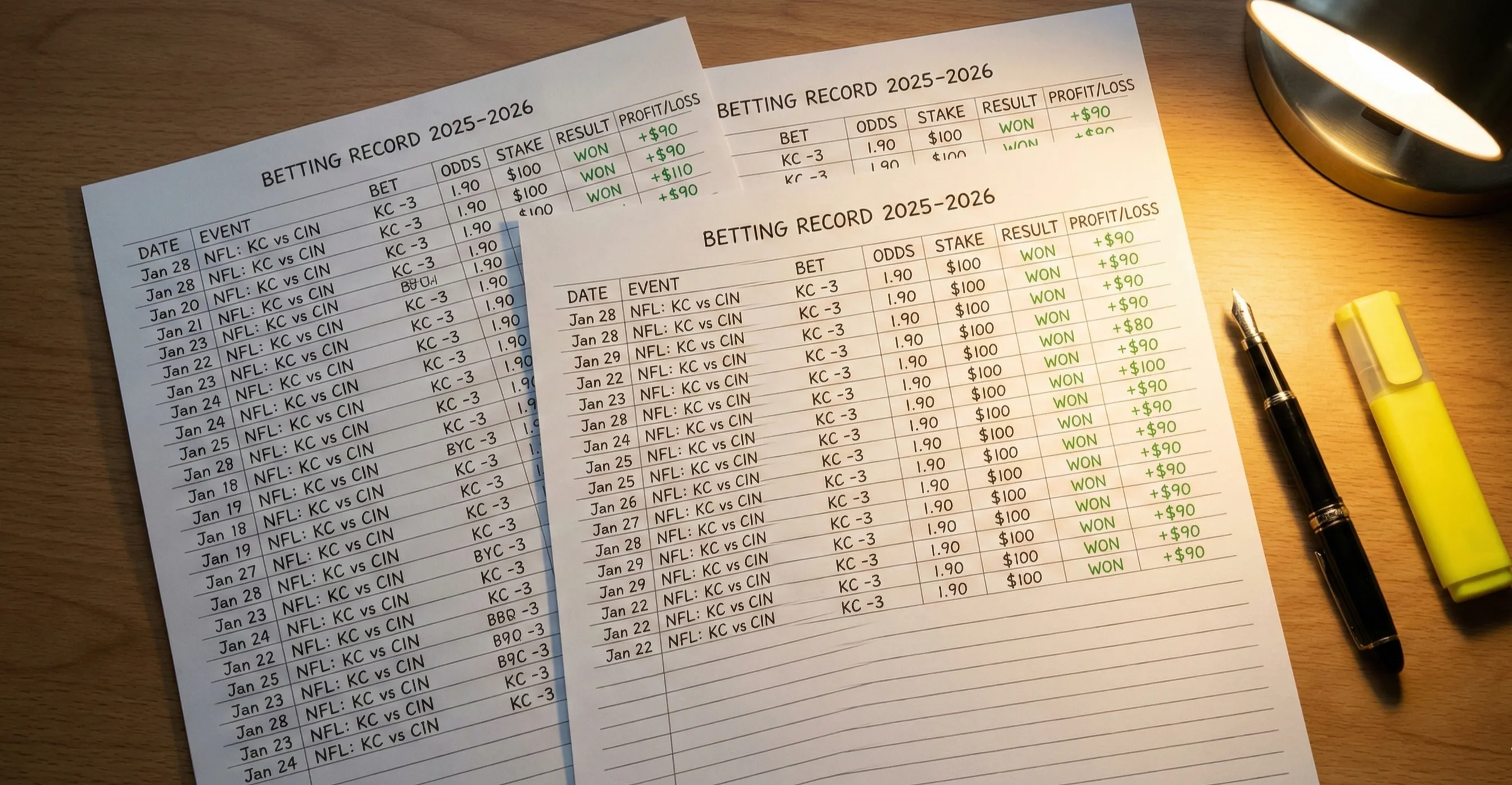
ATS stands for Against The Spread, indicating a team’s record when accounting for point spreads. A team might be 10-6 straight up but 8-8 ATS. ATS records reveal how teams perform relative to expectations rather than just wins and losses. Handicappers track ATS records by situation, venue, and opponent type.
ROI means Return on Investment, calculated as profit divided by total amount wagered. A bettor who wagered $10,000 and profited $500 has a 5% ROI. Serious bettors use ROI rather than win rate because it accounts for varying odds. A 55% win rate at -110 produces different ROI than 55% at average odds of +120.
Unit is a standardized bet size that represents a percentage of your bankroll. Most bettors use 1-5% of their bankroll as a unit. Tracking results in units rather than dollars allows comparison across different bankroll sizes. “I’m up 20 units this season” is more meaningful than “I’m up $2,000” without knowing bankroll context.
CLV stands for Closing Line Value, measuring whether you beat the closing number. If you bet Cowboys -3 and they closed at -4.5, you got 1.5 points of CLV. Consistently achieving positive CLV correlates strongly with long-term profitability. Professional bettors use CLV as their primary performance metric.
Buying Points means paying additional juice to get a more favorable spread or total. Buying a half-point might move -7 to -6.5 but change your odds from -110 to -125. Whether buying points offers value depends on the specific numbers involved. Buying through key numbers like 3 and 7 in football can be worthwhile.
Circle Game is a game with reduced betting limits, typically due to injury uncertainty, weather concerns, or unusual circumstances. Sportsbooks circle games when they’re unsure about a key factor that might dramatically affect the outcome. Finding and betting circle games at other books before they’re circled can capture value.
This vocabulary forms the foundation of sports betting literacy. Master these terms and you’ll understand betting content, communicate with other bettors effectively, and interpret what sportsbooks are telling you through their lines and limits. The language of betting exists because the concepts it describes matter for making informed wagering decisions.
See also all articles.
