

Every sportsbook in existence operates as a business, and like any business, it needs revenue to survive. That revenue comes primarily from a mechanism so elegantly hidden in plain sight that most recreational bettors never fully appreciate its impact on their bottom line. This mechanism has many names: juice, vig, vigorish, the cut, the take, or simply the margin. Whatever you call it, understanding how it works represents the first step toward becoming a more sophisticated bettor.
The vig is not a separate fee that appears on your receipt after placing a bet. You won’t find a line item reading “sportsbook commission: $10.” Instead, the vig is baked directly into the odds themselves, subtly tilting the mathematics in the house’s favor on every single wager you place. This invisible tax operates around the clock, across every sport and market, quietly extracting value from the betting public one wager at a time.
Juice and vig explained on brom bet.
The Mechanics of Vigorish
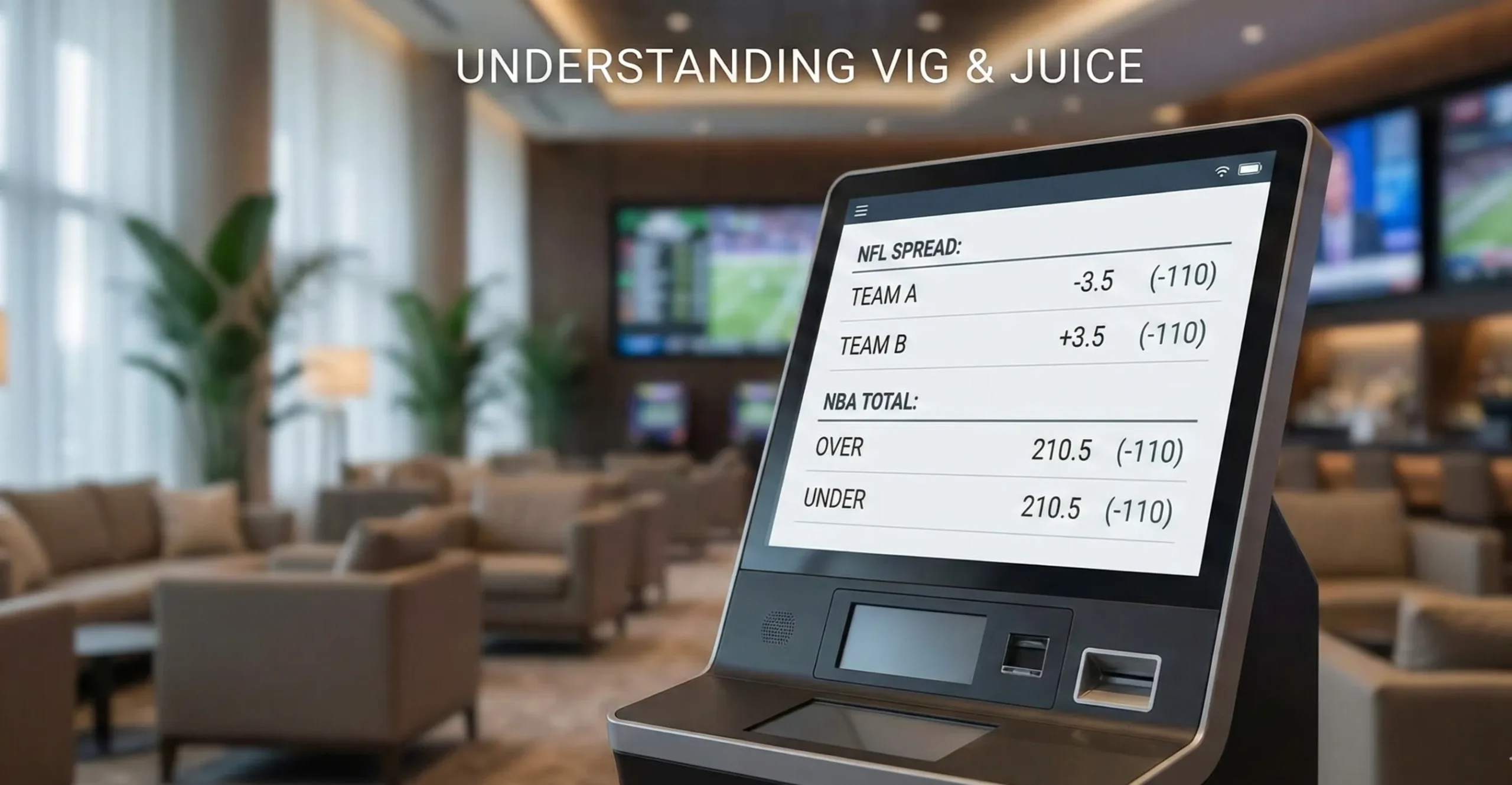
When you see a point spread listed at -110 on both sides, you’re looking at the vig in its most common form. That -110 means you must risk $110 to win $100, or proportionally, $11 to win $10. The extra $10 above your potential winnings represents the sportsbook’s commission. In a perfect world where betting were truly fair, both sides of a 50/50 proposition would be listed at +100, or even money, meaning you’d risk $100 to win $100.
The mathematics reveal why the vig guarantees sportsbook profitability. Consider a hypothetical scenario where a sportsbook takes exactly $110 in wagers on each side of a point spread. The total handle is $220. Regardless of which side wins, the sportsbook pays out $210 to the winners, keeping $10 as profit. That $10 divided by $210 equals roughly 4.76%, which represents the theoretical hold on standard -110 juice.
This arrangement means bettors face an uphill battle from the moment they place a wager. To break even at -110 odds over the long term, you need to win approximately 52.4% of your bets, not the intuitive 50% that many assume. That extra 2.4% doesn’t sound like much until you realize it compounds across hundreds or thousands of bets, steadily eroding bankrolls that would otherwise remain stable.
Calculating True Probability and Implied Odds

The vig distorts the relationship between betting odds and true probability. When a sportsbook offers -110 on both sides of a spread, each side carries an implied probability of about 52.4%, totaling 104.8% when combined. That extra 4.8% above 100% represents the overround, or the mathematical cushion built into the odds.
To calculate implied probability from American odds, you need different formulas depending on whether the odds are positive or negative. For negative odds like -110, divide the absolute value of the odds by itself plus 100, then multiply by 100 to get a percentage. So for -110: 110 divided by 210 equals 0.524, or 52.4%. For positive odds like +150, divide 100 by the odds plus 100. So +150 becomes 100 divided by 250, equaling 0.40 or 40%.
Understanding this calculation allows you to identify the true vig on any market. Add up the implied probabilities of all possible outcomes; anything above 100% represents the vig. A two-way market with -110 on each side has a combined implied probability of 104.8%, meaning the vig is 4.8%. A moneyline featuring -200 and +170 combines to about 105.8%, indicating slightly higher juice. Some prop markets can reach 15% or higher, particularly in futures markets where sportsbooks pad their margins to account for the uncertainty of long-term predictions.
How Vig Varies Across Markets and Sportsbooks
Not all bets carry the same juice. Point spreads and totals typically feature the industry-standard -110, representing about 4.5% to 5% vig. Moneylines on lopsided matchups often carry higher juice because sportsbooks need protection against one-sided action. When you see a favorite at -300 and an underdog at +240, the implied probabilities add up to about 79.4% on the favorite and 29.4% on the underdog, totaling 108.8% and indicating nearly double the standard vig.
Futures markets are where sportsbooks really pad their margins. When you’re picking one team from a field of 30 to win a championship, the combined implied probabilities of all outcomes might exceed 125%. That extra 25% or more represents pure profit margin for the book. Player props and exotic bets similarly tend to carry elevated juice because these markets receive less betting volume and present greater pricing uncertainty.
The variation extends across different sportsbooks as well. Some operators run leaner margins to attract sharp bettors, offering -105 or even -102 on spreads and totals. Others target recreational players with higher juice, knowing their customer base won’t shop for better prices. The difference between -110 and -105 might seem trivial on a single bet, but it dramatically impacts long-term profitability. At -105, the break-even win rate drops to about 51.2%, giving you an extra 1.2% margin compared to standard juice.
The Cumulative Impact on Your Bankroll
The true cost of vig becomes apparent only when you zoom out and examine its effect over many bets. Suppose you place 100 bets at -110, risking $110 on each to win $100. If you win exactly 50 of those bets, you’d collect $5,000 in winnings but lose $5,500 on your losses, netting a $500 deficit. You haven’t made any particularly bad picks; you’ve simply paid the cost of doing business with the sportsbook.
To actually profit at -110 odds, you need to win at least 53 of every 100 bets. At that rate, you’d win $5,300 and lose $5,170, netting a modest $130 profit. This illustrates why professional bettors obsess over finding edges measured in single percentage points. The margin for error is razor-thin, and the vig constantly works against you.
The impact compounds when you factor in the reality that most bettors place wagers with higher juice than the standard -110. Parlay bettors face particularly steep odds because the vig multiplies with each leg added to the ticket. Same-game parlays often carry even higher embedded juice because sportsbooks charge extra for the correlation between outcomes. What looks like an attractive +600 payout might carry an effective vig of 20% or more when you reverse-engineer the individual leg prices.
Strategies for Minimizing Vig Impact

The most effective strategy for reducing vig’s impact on your betting results involves maintaining accounts at multiple sportsbooks and shopping for the best lines before every bet. The difference between -110 and -105 on a single wager might only save you $5 on a $110 bet, but that same discipline applied across a year of betting translates to substantial savings. Professional bettors consider line shopping non-negotiable precisely because small edges accumulate into significant advantages.
Some sportsbooks periodically offer reduced juice promotions, dropping standard lines from -110 to -105 or even -100 on selected games. These promotions effectively give you free money compared to betting at standard prices, and serious bettors actively seek them out. Similarly, certain books consistently offer reduced juice across their entire board as a competitive differentiator, targeting value-conscious bettors willing to sacrifice a flashier interface for better prices.
Betting exchanges represent another avenue for avoiding traditional sportsbook vig. These platforms allow bettors to wager against each other rather than against the house, with the exchange taking a small commission on net winnings rather than building margin into the odds. The result is often significantly better prices than traditional sportsbooks, though liquidity can be limited on less popular markets.
Finally, becoming more selective about which bets you place naturally reduces the vig’s toll on your bankroll. Every wager you skip is a wager that doesn’t carry juice. Focusing your action on markets with lower vig and situations where you have genuine edge maximizes your chances of overcoming the built-in house advantage. The recreational approach of betting every game or chasing action on unfamiliar sports guarantees you’ll pay maximum juice for minimum insight.
Why the Vig Exists and What It Means for You
Sportsbooks aren’t charities, and the vig represents their compensation for providing a marketplace where bettors can act on their opinions. They employ teams of traders and analysts, maintain sophisticated technology platforms, and assume significant risk when sharp bettors identify mispriced lines. The vig funds these operations and generates the profits that keep the industry running.
For bettors, the vig serves as a constant reminder that sports betting is a negative-sum game in aggregate. The money flowing out to winners comes from losing bettors minus the sportsbook’s cut. Unlike poker, where skilled players can profit indefinitely from weaker competition, sports betting requires you to beat both the sportsbook’s prices and the implicit tax embedded in every wager.
This reality shouldn’t discourage informed betting, but it should calibrate your expectations. Beating the vig over the long term requires genuine skill, rigorous discipline, and relentless attention to value. Most bettors never achieve consistent profitability, and the vig is the primary reason why. Understanding its mechanics and impact represents the foundation upon which all other betting knowledge builds. Without this foundation, you’re simply playing a game you don’t fully understand, and in gambling, ignorance is never bliss.
See also how to read odds.
