


The moment your futures bet reaches the championship game or your parlay survives to its final leg, a peculiar anxiety sets in. You’ve come so far, beaten so many odds, and now everything rides on a single outcome. The potential payout glows tantalizingly on your screen while the possibility of walking away empty-handed haunts your thoughts. This is precisely the situation where hedging transforms from abstract concept to urgent necessity.
Hedging involves placing a second bet against your original position to guarantee some profit or reduce potential losses regardless of the final outcome. It’s essentially buying insurance for your wagers, trading maximum upside for certainty. The strategy divides the betting community: some view hedging as prudent risk management while others consider it a weak betrayal of your original conviction. The truth lies somewhere between, depending entirely on your personal situation and the specific mathematics involved.
How to hedge your bets on brom bet.
Understanding Hedge Bet Mechanics
At its core, hedging means betting on the opposite outcome of your existing wager. If you have a futures ticket on the Chiefs to win the Super Bowl, you hedge by betting on their opponent. If your parlay needs the Eagles to cover for a massive payout, you hedge by betting against the Eagles. The two bets create opposing positions that guarantee you collect on one regardless of results.
The hedge amount determines how your final outcomes look. A full hedge locks in equal profit no matter who wins, eliminating all variance but also capping your maximum return. A partial hedge guarantees some profit while leaving additional upside if your original bet wins. No hedge means riding the original bet to maximum potential profit or total loss.
Calculating the optimal hedge requires knowing four numbers: your original stake, the potential payout if your original bet wins, the odds on the hedge bet, and your desired outcome structure. From these inputs, straightforward arithmetic tells you exactly how much to wager on the hedge to achieve whatever profit distribution you want.
The mathematics work because your original bet’s value has increased since you placed it. A +2000 futures bet that reaches the championship game now represents significant equity even though the bet hasn’t technically won. Hedging converts that paper equity into guaranteed cash, which is why hedging opportunities exist primarily when your original position has improved dramatically.
When Hedging Makes Strategic Sense
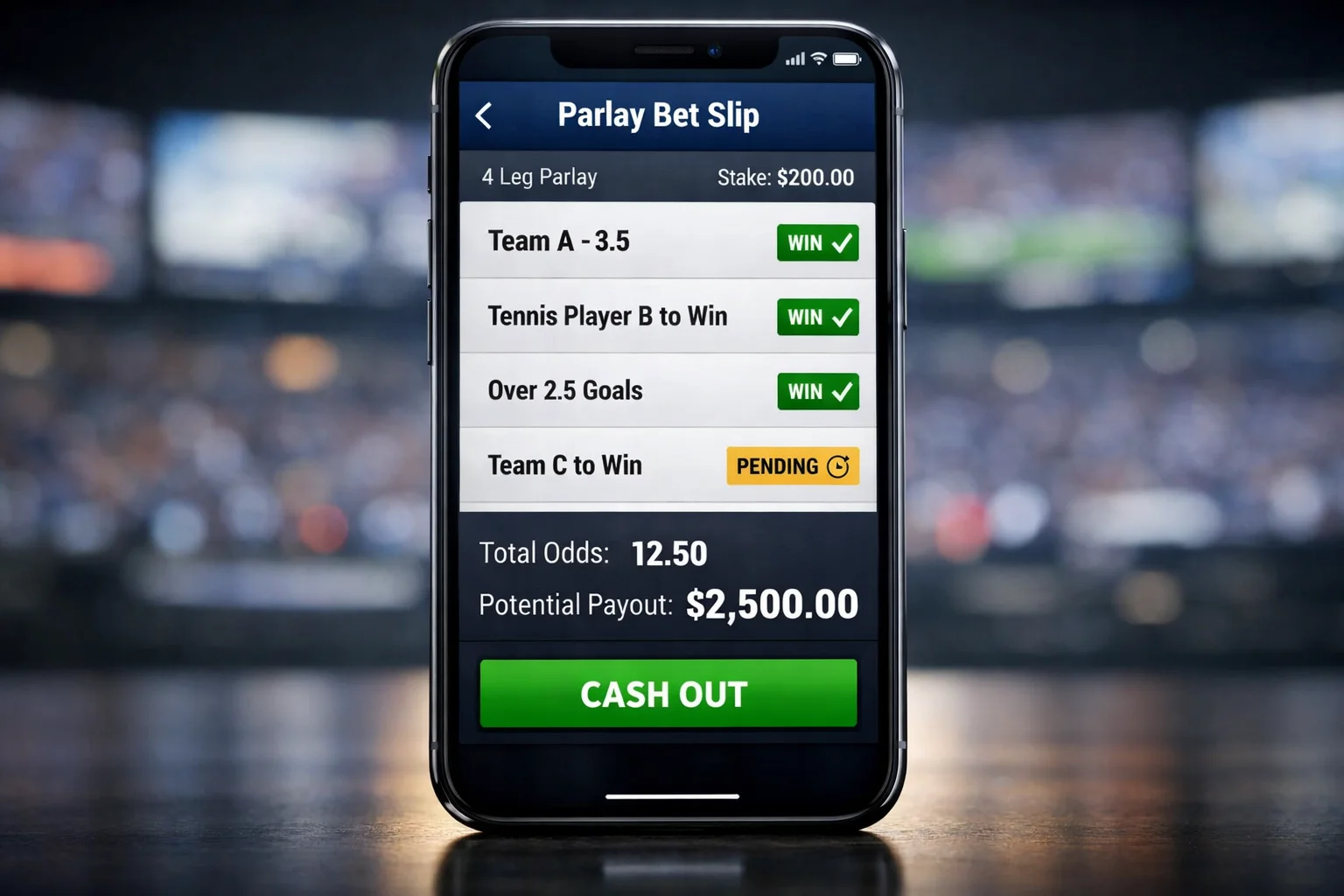
Futures bets present the most classic hedging opportunities. You place a season-long bet at high odds, your team advances through the playoffs, and suddenly you’re facing a championship game with life-changing money on the line. The original $100 bet that could win $2,000 has genuine current value, and hedging lets you realize that value regardless of the final game’s outcome.
Parlays create similar situations when all but one leg has won. Your five-team parlay paying +2500 needs only the Sunday night game to hit. Rather than sweating that final leg with everything on the line, you can bet the other side to guarantee walking away a winner. The guaranteed amount will be less than the full parlay payout, but it eliminates the gut-wrenching possibility of going 4-1 and collecting nothing.
Live betting opens dynamic hedging opportunities as games unfold. If you bet an underdog pregame and they jump to a big lead, you can hedge by betting the favorite live at now-improved odds. The early lead might not hold, but your hedge ensures you profit either way. This approach requires quick decision-making and access to favorable live odds.
Hedging also makes sense when circumstances change after you place your original bet. Injury news, weather developments, or lineup changes might significantly alter your confidence without being fully reflected in current odds. A hedge lets you reduce exposure to your now-uncertain original position without completely abandoning it.
Calculating Hedge Amounts for Equal Profit
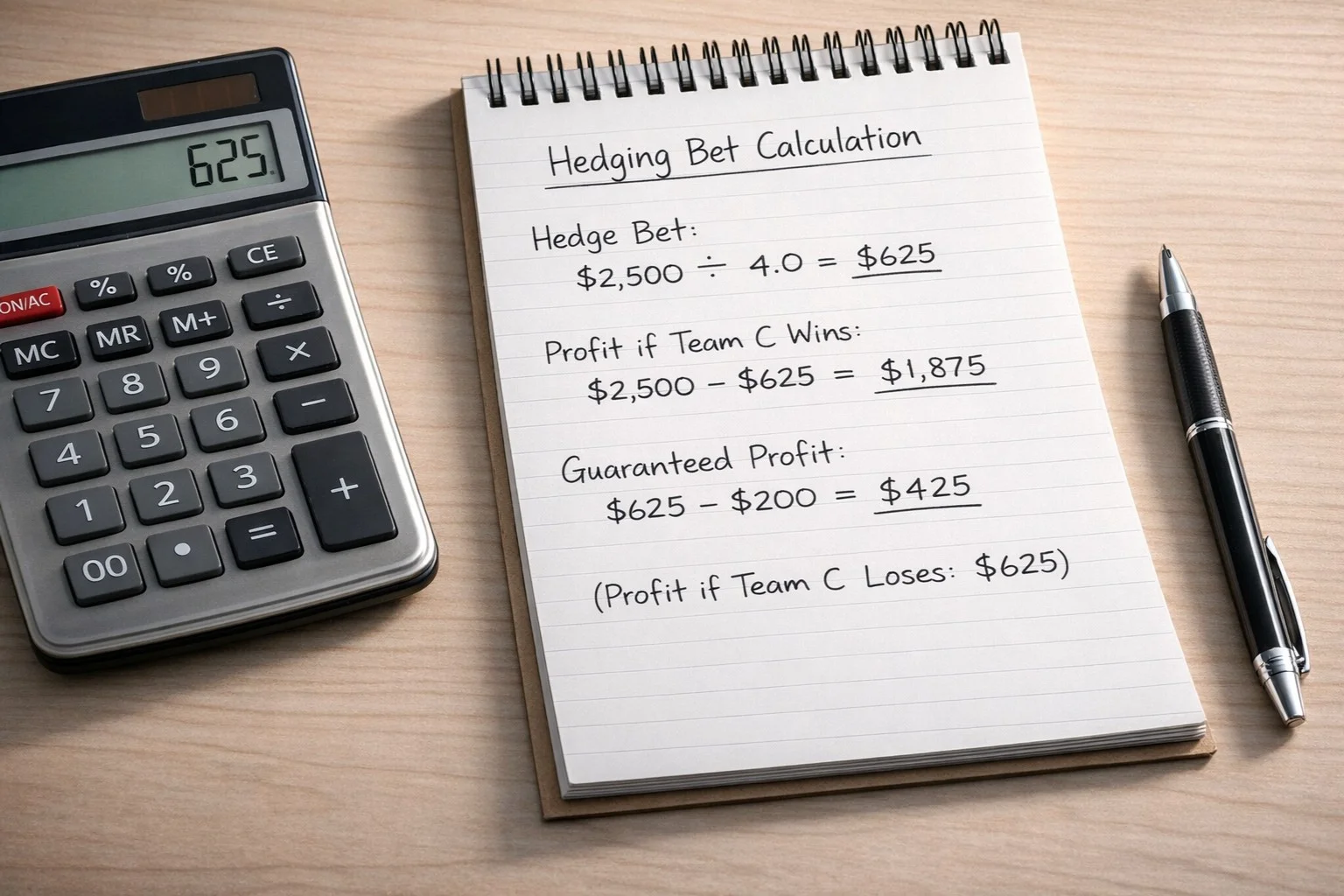
The most common hedging goal is locking in equal profit regardless of outcome. This requires calculating how much to bet on the hedge so that both scenarios produce identical returns.
The formula involves finding the amount that makes your hedge payout equal your original payout minus the hedge stake. If your original bet will pay $2,100 total (including stake return) and the hedge odds are +120, you need to find the hedge amount where winning the hedge pays $2,100 minus that hedge amount.
Working through the math: with a $100 original bet at +2000 odds, winning pays $2,100. Your hedge opponent is +120. To guarantee equal profit, divide your original potential payout by (1 + decimal hedge odds). So $2,100 / 2.20 = $954.55. Betting $954.55 at +120 wins $1,145.45, totaling $2,100. If your original wins, you get $2,100 minus the $954.55 hedge loss, netting $1,145.45. If the hedge wins, you get $2,100 minus your original $100 loss, also netting about $1,145. Either way, you lock in roughly $1,045 profit.
Online hedge calculators automate these calculations, letting you input your original bet details and hedge odds to instantly see the required stake and guaranteed profit. Using these tools prevents arithmetic errors that could throw off your intended hedge structure.
Partial Hedging Strategies
Full hedges guarantee equal outcomes but sacrifice the maximum upside of your original bet hitting. Partial hedges offer a middle ground: guarantee some minimum profit while preserving significant additional upside if the original wins.
A partial hedge involves betting less than the amount needed for equal profit on both sides. Using the previous example, instead of betting $954 on the hedge, you might bet $500. If the original wins, you keep $2,100 minus the $500 hedge loss, netting $1,500. If the hedge wins, you get $500 × 2.20 = $1,100 minus your original $100 loss, netting $1,000. You’ve guaranteed at least $1,000 profit while keeping the possibility of $1,500 if your original conviction proves correct.
The specific partial hedge amount depends on your risk tolerance and beliefs about the final outcome. If you still strongly favor your original position, a smaller hedge preserves more upside. If you’ve lost confidence or simply can’t stomach the variance, a larger hedge reduces the outcome gap between scenarios.
Some bettors use graduated hedging strategies, taking partial hedges at multiple points as their position improves. A futures bettor might hedge slightly after the conference championship round, then hedge more aggressively before the final. This approach captures value at different stages rather than making one all-or-nothing hedge decision.
The Expected Value Argument Against Hedging
Critics of hedging argue that it’s mathematically suboptimal when your original bet represented positive expected value. If you had edge when placing the original wager, hedging involves placing a second bet that likely carries negative expected value (due to the vig), reducing your overall expectation.
The logic is straightforward: if your original bet was +EV, and your hedge bet is -EV, combining them produces lower expected value than simply letting the original ride. You’re essentially paying for emotional comfort rather than maximizing mathematical returns.
This argument assumes you correctly identified value in your original bet and that your probability assessment remains accurate. It also ignores the utility function of money, where guaranteed smaller amounts may be worth more to you than their mathematical expectation suggests. Winning $1,000 guaranteed might be more valuable to your life than a 50% chance at $2,000, even though the expected values are equal.
Professional bettors with large bankrolls and long time horizons often let positions ride without hedging, accepting variance in pursuit of maximum expected value. Recreational bettors with smaller bankrolls and less tolerance for swings often prefer locking in meaningful profits when the opportunity arises. Neither approach is objectively wrong; they reflect different circumstances and preferences.
Common Hedging Mistakes to Avoid
Over-hedging destroys the value you’ve built in your original position. If you hedge so aggressively that your guaranteed profit becomes minimal, you’ve essentially given away equity for nothing. Calculate your hedge amounts carefully and ensure the guaranteed outcome is actually worth locking in.
Under-hedging leaves you exposed to more risk than you intended. If you meant to guarantee $500 profit but miscalculated and guaranteed only $50, you haven’t accomplished your hedging goal. Double-check your math before placing hedge bets.
Hedging too early locks in value before it’s maximized. If your futures team has another round to win before the championship, hedging now captures less value than hedging later would. Of course, they might lose the interim round, eliminating your hedge opportunity entirely. This timing decision involves assessing both probability and risk tolerance.
Ignoring the hedge bet’s own vig inflates your expectations. The odds on your hedge include the sportsbook’s margin, meaning you’re paying juice on the second bet. Account for this cost when calculating whether hedging makes sense.
Emotional hedging based on anxiety rather than analysis leads to poor decisions. Some bettors hedge every time they feel nervous, regardless of whether the mathematics support it. Develop criteria for when hedging makes sense and stick to them rather than reacting emotionally to each situation.
Hedging Beyond Futures and Parlays
While futures and parlays present the most dramatic hedging scenarios, the concept applies more broadly. Any position that has gained value since placement can potentially be hedged.
Pregame bets that see favorable line movement create small hedging windows. If you bet a team at -3 and the line moves to -6, you might find value on the other side at +6, creating a middle opportunity where you win both bets if the favorite wins by 4 or 5. This isn’t pure hedging but uses similar concepts.
Season win total futures can be hedged as the season progresses. If you bet a team’s over on season wins and they’re running hot, you might hedge with their opponents in individual games, reducing exposure while the position is profitable.
Player prop futures for awards like MVP can be hedged in championship games or season finales where the award outcome becomes clear. The hedge wouldn’t be on the opposing player but on game outcomes that would lock in your player’s award victory.
See also the cash out feature.
Hedging represents one tool in the broader toolkit of sports betting strategy. It’s neither universally good nor bad but situationally valuable depending on your original position’s status, your personal risk tolerance, and the specific mathematics of available hedge prices. Understanding when and how to hedge effectively adds flexibility to your betting approach, letting you capture value and manage risk in ways that pure conviction betting cannot.
