


The standard parlay represents sports betting’s cruelest structure: link multiple selections together, watch most of them win, then lose everything when a single leg falls short. That devastating all-or-nothing format drives recreational bettors crazy while generating reliable profits for sportsbooks. Round robin betting emerged as a response to this frustration, offering a way to maintain multi-game action while building in some insurance against the inevitable missed leg.
The concept borrows its name from round-robin tournaments where every participant plays every other participant. Applied to betting, the round robin takes your selections and creates every possible parlay combination at a specified leg count. Instead of one big parlay requiring perfection, you get multiple smaller parlays that can produce returns even when some selections lose. The trade-off involves higher total stakes and lower maximum payouts, but for many bettors, that exchange feels worthwhile.
Round robin betting on brom bet.
Understanding Round Robin Structure
A round robin bet starts with your list of selections, typically three to eight games you want to include. Rather than combining them into a single parlay, the sportsbook generates all possible parlay combinations at the parlay size you specify. You then bet an equal amount on each of these combinations.
The simplest example uses three selections with two-team parlays. If you like Team A, Team B, and Team C, a round robin creates three separate two-team parlays: A+B, A+C, and B+C. If you bet $10 on each parlay, your total stake is $30. Should any two of your three selections win, at least one parlay cashes.
The mathematics expand quickly as selections increase. Four teams at two-leg parlays produces six combinations. Five teams creates ten combinations. If you add three-leg parlays to the mix, a five-team round robin generates ten two-leg parlays, ten three-leg parlays, and five four-leg parlays, for 25 total combinations. Some bettors include the full parlay of all selections as well.
This structure provides graduated returns based on performance. Go 3-0 on a three-team round robin with two-leg combinations, and all three parlays win. Go 2-1, and one parlay still cashes while two lose. Only going 1-2 or worse results in losing all three parlays. You’ve essentially built a buffer that rewards partial success rather than demanding perfection.
Calculating Round Robin Payouts

The potential returns from round robins require more complex calculation than standard parlays because you’re analyzing multiple separate bets with different possible outcomes. Each combination within the round robin pays according to its individual odds, and your total return depends on which specific combinations hit.
Consider a three-team round robin with two-leg parlays at standard -110 juice on each selection. Each two-leg parlay pays approximately +264, meaning a $10 bet returns about $36.40. Your total stake across three parlays is $30. If all three teams win, all three parlays cash for $109.20 total return, representing $79.20 profit on $30 risked.
If two teams win and one loses, one parlay cashes while two lose. You’d collect $36.40 from the winning parlay while losing $20 on the two losing parlays, netting $6.40 profit. This outcome, impossible with a standard three-leg parlay, illustrates the round robin’s insurance function. Going 2-1 still produces a positive result.
If only one team wins or all three lose, every parlay loses and your $30 stake disappears. The round robin doesn’t protect against poor overall performance; it only provides cushion against a single miss when most selections succeed.
The break-even math depends on the specific configuration. For a three-team round robin with two-leg parlays at standard odds, you need to average better than 66% individual selection success to profit long-term. This threshold exceeds what most recreational bettors achieve, which is why round robins, despite their insurance features, remain negative-expected-value bets for players without genuine analytical edges.
When Round Robins Make Strategic Sense
Round robins fit specific situations better than standard parlays without fundamentally changing the mathematics of multi-leg betting. Understanding when they add value helps you deploy them appropriately.
High-confidence selections with unpredictable variance represent prime round robin candidates. If you’ve identified several games where you believe you have edges but acknowledge the inherent randomness of sports outcomes, the round robin lets you maintain exposure to your analysis while absorbing the occasional upset. Weather-affected games, divisional matchups with historical volatility, or other high-variance situations fit this profile.
Hedging and bankroll protection scenarios also favor round robins. If you want parlay-level action but can’t afford the all-or-nothing risk, the round robin’s structure spreads that risk across multiple tickets. Going 4-1 on five games feels terrible when it kills your five-leg parlay but acceptable when it cashes several of your round robin combinations.
Entertainment value drives many round robin decisions. The format keeps you invested across multiple games without the cliff-edge anxiety of a single parlay. One missed leg doesn’t end your night; it just reduces your final payout. For recreational bettors prioritizing engagement over pure expected value, this emotional smoothing has genuine utility.
Round robins make less sense when you have a single high-conviction play or when the parlay combinations produce unattractive prices. They also become unwieldy and expensive with too many selections, requiring substantial capital to fund all the resulting combinations.
Round Robin Terminology and Variations
Sportsbooks use various names for specific round robin configurations, borrowed from European betting tradition where these bet types have long histories.
A Trixie combines three selections into four bets: three two-leg parlays plus one three-leg parlay. This ensures maximum return if all three hit while still providing cushion for a single loss. The three-leg parlay adds upside beyond a simple three-team, two-leg round robin.
A Yankee applies the same concept to four selections, creating 11 bets: six two-leg parlays, four three-leg parlays, and one four-leg parlay. The structure becomes expensive but offers numerous ways to profit from various winning combinations.
A Canadian (or Super Yankee) extends to five selections with 26 bets, while a Heinz covers six selections with 57 bets. These larger configurations require significant stakes and produce complex payout tables that can be difficult to evaluate quickly.
Some round robin variations include single bets on each selection alongside the parlays, further increasing the combination count and stake requirements. Others allow bettors to customize which parlay sizes to include, such as only two-leg and four-leg parlays from a five-team selection pool.
Building Effective Round Robin Strategies
The most effective round robin approach involves treating it as a risk-management tool rather than a profit-maximization strategy. You’re accepting lower potential returns in exchange for higher probability of some return.
Limit your selections to three or four teams for most round robins. Larger pools create too many combinations, diluting the insurance effect while inflating total stakes. The sweet spot balances meaningful coverage against manageable capital requirements.
Focus on moderate favorites and reasonable underdogs rather than extreme prices. Heavy favorites reduce parlay payouts without proportionally increasing probability, while massive underdogs rarely hit frequently enough to justify inclusion. The middle ground, sides priced from -150 to +150, typically produces the best risk-adjusted round robin returns.
Avoid mixing sports indiscriminately. While round robins technically allow cross-sport combinations, the different timing and variance profiles create confusing hedge scenarios and payout calculations. Keeping selections within a single sport or league simplifies analysis and result tracking.
Consider the correlation between your selections. Round robins work best when outcomes are independent. If you’re including three teams from the same game or selecting overs that depend on similar conditions, the insurance effect weakens because failures are more likely to occur together.
The Mathematics Behind Round Robin Disadvantages
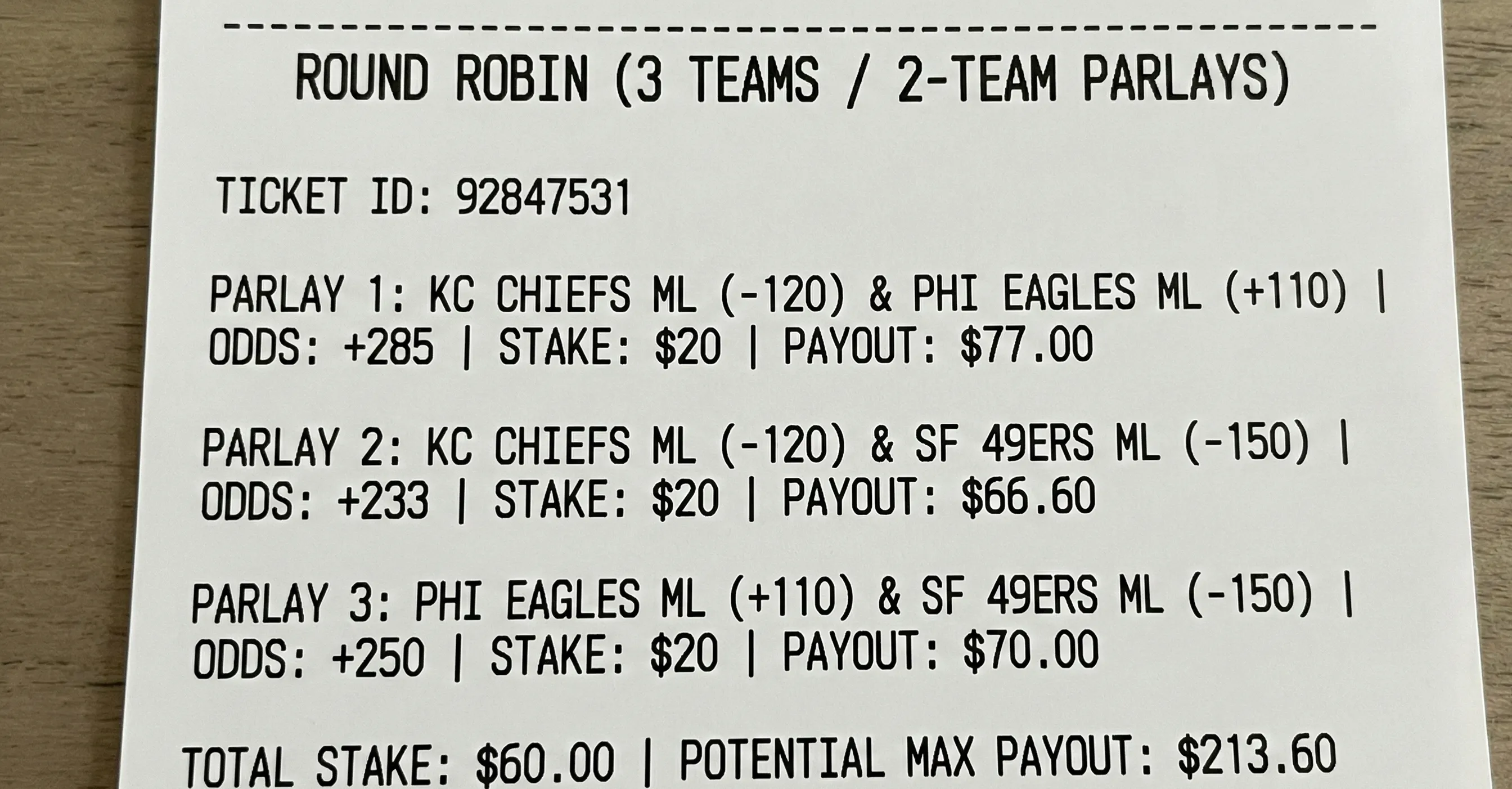
Round robins don’t eliminate the house edge; they spread it across more bets. Each parlay within the round robin carries the same compounded juice as any standard parlay. The insurance against single-leg losses comes entirely from your own pocket through the additional stakes required.
The expected value of a round robin equals the sum of expected values across all component parlays. Since each parlay has negative expected value for bettors without edges, the round robin aggregates those negative expectations. More combinations mean more juice paid to the sportsbook.
This mathematical reality explains why professional bettors rarely use round robins. If you have genuine edges on multiple games, betting them as straight bets preserves more expected value than combining them into any parlay structure. The insurance round robins provide has a cost, and that cost often exceeds the benefit for skilled handicappers.
Recreational bettors might reasonably accept this trade-off for entertainment purposes. The question becomes whether the emotional value of staying alive after a single miss justifies the mathematical cost of the round robin structure. There’s no universally correct answer; it depends on individual preferences and bankroll situations.
Practical Round Robin Implementation
Most online sportsbooks include round robin options directly in their parlay builders. After selecting multiple games, you’ll see options to create round robin combinations at various leg counts. The interface typically shows total stake required and potential payouts for different outcome scenarios.
Before confirming any round robin, verify the total stake matches your intended investment. It’s easy to accidentally commit more money than planned when numerous combinations are involved. A five-team round robin with two, three, and four-leg combinations plus the full five-leg parlay creates 26 bets; at $10 each, that’s $260 total.
Track round robin results systematically to evaluate performance over time. Recording individual game outcomes, parlay results, and overall profit or loss helps you understand whether this bet type works within your broader betting approach.
Set clear rules for when you’ll use round robins versus standard parlays or straight bets. Arbitrary decision-making leads to inconsistent results and makes performance evaluation impossible. Whether your trigger is number of games you like, confidence level, or available bankroll, having predetermined criteria improves long-term discipline.
Round robins occupy a middle ground between the high-risk, high-reward standard parlay and conservative straight betting. They won’t transform losing bettors into winners, but they can make multi-game action more sustainable for those who understand and accept their limitations. Used thoughtfully, they’re a legitimate tool. Used carelessly, they’re just a more complicated way to donate money to sportsbooks while feeling slightly less devastated by near-misses.
See also parlay betting.
